1. Home
  2. |
  3. From bottlenecks to continuous production at abeka print shop

From bottlenecks to continuous production at Abeka Print Shop

For many years, Abeka Print Shop relied on long-run offset production to achieve the lowest possible cost per page. As demand patterns evolved, however, high inventory levels reduced flexibility and made it difficult to respond quickly to changing requirements. To support a more agile, demand-driven production model, Abeka invested in digital web inkjet printing with Contiweb non-stop unwinding technology.

While digital printing delivered the desired flexibility, inline finishing constrained press performance and introduced frequent interruptions. By decoupling printing and finishing and transitioning to a roll-to-roll workflow, Abeka eliminated this bottleneck, increasing press speeds to around 650 ft/min (198 m/min) and creating a more stable and efficient production environment.

Key results:

  • Transitioned from long-run offset production to a flexible, demand-driven digital print model.

  • Eliminated finishing bottlenecks through Contiweb-enabled roll-to-roll production.

  • Increased press speeds from 150 to 650 ft/min (from 46 to 198 m/min).

  • Reduced labour requirements and eliminated the need for student workers.

  • Improved productivity with Contiweb’s automated non-stop unwinding and rewinding technology.

About Abeka Print Shop

Abeka Print Shop, an in-plant printing operation based in Pensacola, Florida, produces Christian educational materials such as books, catalogues and promotional content and operates a diverse production environment with around 50 employees. Serving its internal distribution organisation, the print shop plays a critical role in ensuring timely delivery of materials to end users.

For many years, Abeka relied heavily on long-run offset production. Large volumes were printed in advance—sometimes covering up to three years of demand—in order to optimise cost per page. While effective from a traditional efficiency perspective, this model increasingly conflicted with the need for flexibility and responsiveness.

As demand patterns evolved, the limitations of this approach became clear. High inventory levels tied up capital, while the inability to respond quickly to changing requirements led to significant backorders during peak periods. At one point, these backorders exceeded 100 titles, creating pressure across the entire operation.

To address these challenges, Abeka made a strategic shift toward digital printing, enabling a more agile, demand-driven production model in which books could be printed in the exact quantities required, exactly when needed.

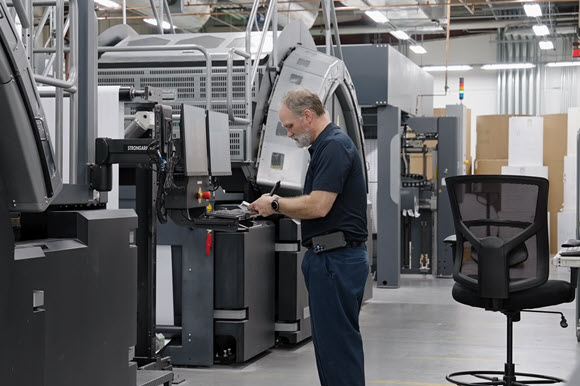
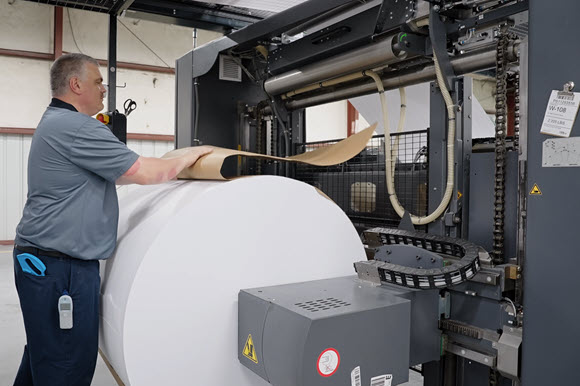
HP T490 press line with operator at Abeka Print Shop

Making the shift to digital printing

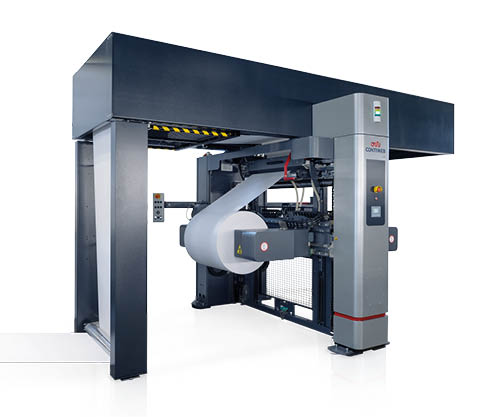
As part of this transition, Abeka installed an HP PageWide Web Press T490, supported by a Contiweb CD-N non-stop unwinder. Building on positive experiences with Contiweb equipment on existing web offset presses, the choice for Contiweb was a natural one, driven by confidence in the robustness of the technology and the quality of service and support.

The initial production setup combined digital printing with inline finishing, allowing book blocks to be produced in a single, continuous process. In theory, this created a highly efficient workflow in which printed output could move directly into finishing and binding without interruption.

In practice, however, the complexity of the finishing process introduced new challenges.

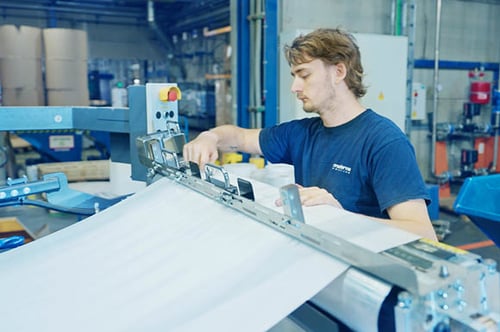
Operator working with Contiweb CD-N at Abeka Print Shop

When inline finishing becomes a bottleneck

While inline finishing offered clear advantages for short runs and immediate output, it also created a critical dependency between printing and finishing. Any issue in the finishing line—whether related to perforation, folding, punching or cutting—would immediately stop the entire production process.

As Curtis O’Morrow, Press Production Manager, explains, “if anything in the finishing line didn’t run perfectly, it would immediately stop the press. We had multiple processes in line—perforation, folding, hole punching—and if one of those had an issue, the entire production flow would come to a halt.”

This dependency meant the digital press could not run at its designed performance level. Speeds had to be reduced significantly to match the limitations of the finishing line, in some cases dropping to as low as 150 feet (46 meter) per minute.

The result was a production bottleneck that not only reduced throughput but also created a misleading perception of underperformance at press level. In reality, it was the finishing configuration that constrained output.

"If anything in the finishing line didn’t run perfectly, it would immediately stop the press."

Curtis O’Morrow, Press Production Manager, Abeka Print Shop

Decoupling print and finishing for maximum performance

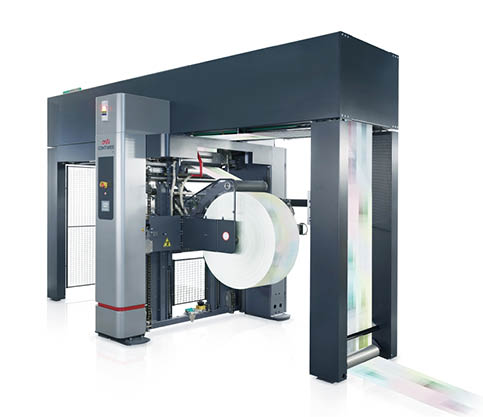
To eliminate this bottleneck, Abeka made the strategic decision to decouple printing and finishing by introducing a Contiweb CR-N rewinder and moving to a roll-to-roll production model. This allowed the press to run independently, producing printed rolls that could be processed later in a separate finishing stage.

The difference was immediately noticeable. As O’Morrow describes, “since moving away from inline finishing, we start the shift and the press just keeps running. We’re no longer dealing with constant stops, and that has completely changed the way we operate.”

He adds that “instead of stopping between jobs, we’re now running continuously from one job to the next, which has had a big impact on how much we can produce in a given shift.”

Press speeds increased significantly as well, reaching around 650 feet (198 meter) per minute, with further improvements expected as operators continue to gain experience with the new setup.

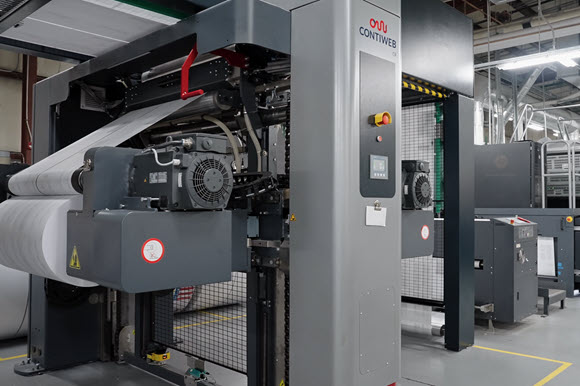
Contiweb CR-N with HP T490 at Abeka Print Shop

A more efficient and stable operation

The move to roll-to-roll production also delivered clear operational benefits beyond throughput alone. Labour requirements were reduced, as fewer operators were needed to manage the process. As O’Morrow explains, “by moving to a roll-to-roll setup, we no longer needed additional support like student workers. The line can now be run by a small, consistent team, which immediately reduced labour requirements.”

At the same time, the overall stability of the production process improved significantly. By removing finishing from the critical path, one of the main sources of disruption was eliminated. Instead of managing a complex, interruption-prone workflow, operators can now focus on maintaining a consistent production flow.

This shift has also contributed to a calmer working environment on the shop floor, where fewer interruptions and less manual intervention reduce pressure on operators and make the process more predictable.

"The line can now be run by a small, consistent team, which immediately reduced labour requirements.”"

Curtis O’Morrow, Press Production Manager, Abeka Print Shop

The role of non-stop auto-splicing technology

Central to this performance is the combination of the Contiweb CD-N and CR-N. The CD-N non-stop unwinder enables continuous production at the infeed by automatically splicing a new roll without stopping the press, while the CR-N rewinder ensures the same continuity at the outfeed.

As printed material exits the press, the rewinder builds finished rolls and transfers the web to a new core without interrupting production. This can happen automatically when a roll reaches its maximum diameter, but can also be initiated earlier by the operator, for example at the end of a print job or when it is more practical to start downstream finishing. In this way, production remains fully continuous while still aligning with job structure and finishing requirements.

From an operator perspective, ease of use is key. As Joseph “BJ” Grosnick, Press Lead, explains, “once the splice is prepared and set, the system basically runs itself. Operators can focus on the rest of the process instead of constantly managing the unwind. It really is a set-it-and-forget-it solution.”

This simplicity reduces operator workload and creates a more stable and predictable workflow. As Grosnick also notes, “the Contiweb equipment is one of the most robust parts of the entire line. It runs consistently, and operators don’t have to worry about it, which makes a big difference in day-to-day operations.”

Unlock the full potential of your digital press

Abeka’s transition to digital printing has enabled a leaner, more responsive production model. By combining the HP PageWide Web Press T490 with Contiweb’s non-stop unwinding and rewinding technology, the company eliminated finishing bottlenecks, enabled continuous production and unlocked the full potential of its digital press.

Want to find out what non-stop auto-splicing could do for your operation? Speak with one of our experts.

Mattheüs van Seumeren
Sales Manager
+31 6 21 63 84 82
sales@contiweb.com

Mattheüs