1. Home
  2. |
  3. Technology fluid application
BNiD-C-technologiepagina-VervolgpageHeader-1905x536

Fluid Application in roll-to-roll production

Applying water and functional fluids in roll-to-roll production

In roll-to-roll production, material behaviour is never fixed. Paper, paperboard, nonwovens and other hygroscopic or functional substrates continuously react to their environment. Moisture levels, surface properties and electrostatic effects influence how a web runs through a process and how it behaves downstream.

Contiweb’s Fluid Application technology enables the precise, uniform and repeatable application of water and functional fluids to control these variables. By doing so, it helps manufacturers stabilise materials, reduce process variability and achieve predictable, high-quality results across a wide range of substrates and applications.

BNiD-C-technologiepagina-TextMedia-580x386-1

Why moisture control matters in web processing

Roll-to-roll processes are inherently sensitive to environmental and process-related variation. As materials move through printing, converting, coating or finishing steps, they are exposed to heat, airflow, tension changes and contact with machine components.

These influences can result in:

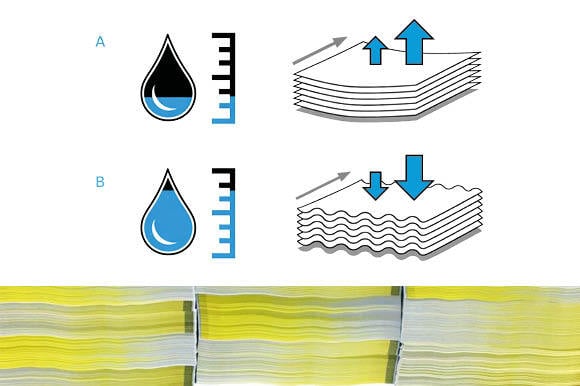
  • curl, waviness or deformation of the web

  • dimensional variation affecting register and finishing accuracy

  • electrostatic effects causing dust attraction, sticking or handling issues

  • increased waste, rework or process interruptions

As production speeds increase and substrates become lighter, more sustainable or more specialised, these effects become harder to compensate for using mechanical adjustments alone.

BNiD-C-technologiepagina-TextMedia-580x386-2C

What is Fluid Application?

Fluid Application refers to the application of liquids onto a moving web with the aim of influencing material behaviour during production and downstream processing. Rather than being a single process step or isolated application, Fluid Application represents a (temporary) functional layer within roll-to-roll production.

This functional layer interacts with the substrate itself, the conditions under which the process takes place, and the requirements of downstream converting, finishing and end-use. Material properties, process speed, temperature, airflow and mechanical interaction all influence the effect of applied fluids and the resulting behaviour of the web.

While often associated with moisture management, Fluid Application also plays a role in addressing surface behaviour and electrostatic effects. Its impact depends not only on the fluid itself, but also on how, where and when it is introduced within the production line.


BNiD-C-technologiepagina-TextMedia-580x386-3

Types of fluids in Fluid Application

Water

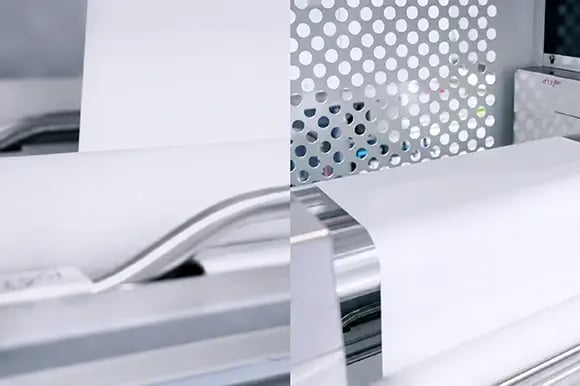
Water is most commonly applied to influence the moisture balance of a substrate. Typical approaches include pre-moistening, moistening and remoistening, each used at different stages of the production process.

These applications are commonly employed to counteract moisture loss caused by drying, heating or environmental exposure, and to influence dimensional behaviour of the web during production and downstream processing.

Functional fluids

In addition to water, a wide range of functional fluids can be applied to influence or add specific material properties. Depending on the application, these fluids may be used to reduce curl or waviness, mitigate electrostatic effects, or improve handling and transport behaviour.

Functional fluids can also be applied to add sensory or functional characteristics, including fragrances, softening or conditioning agents, and surface-modifying additives such as silicones. In these cases, Fluid Application is not only used to stabilise material behaviour, but also to deliberately introduce properties required for downstream processing or end-use performance.

In certain production environments, applying functional fluids earlier in the process can reduce or eliminate the need for corrective measures further downstream.

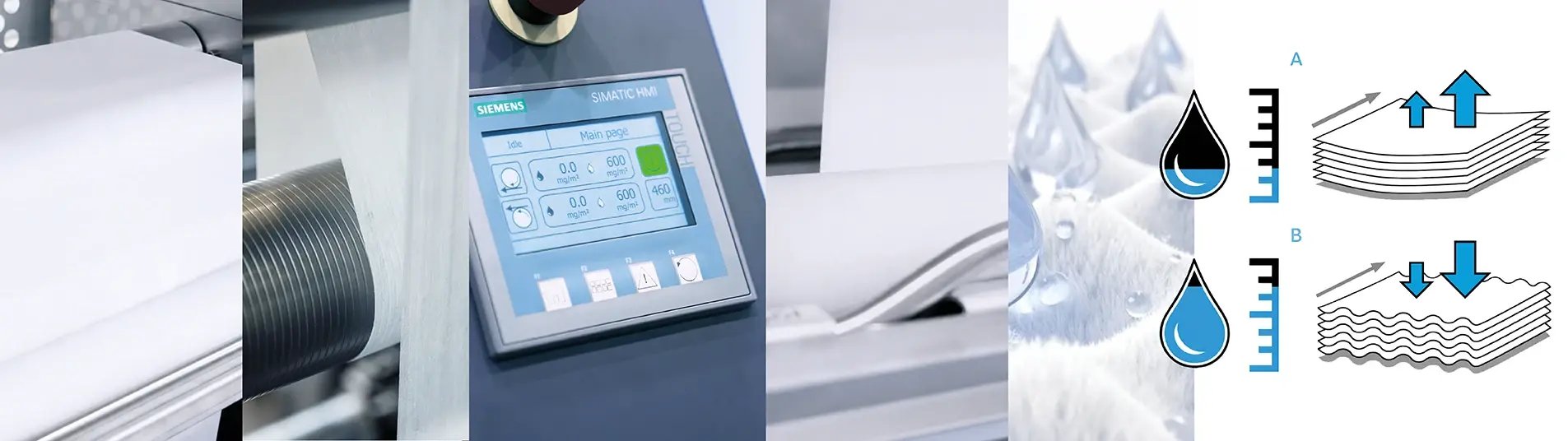
 The Contiweb difference:
Contact rollers and metering technology

While many approaches exist to introduce fluids into roll-to-roll processes, the effectiveness of Fluid Application is ultimately determined by how the fluid is transferred to the web and how precisely the applied amount can be controlled.

Contiweb’s Fluid Application technology is built around two fundamental principles: full-width contact rollers and precision metering. Together, they enable predictable and reproducible interaction between fluid and substrate across a wide range of materials and process conditions.

BNiD-C-TextMedia-DFA-580x386-4

Full-width contact rollers 

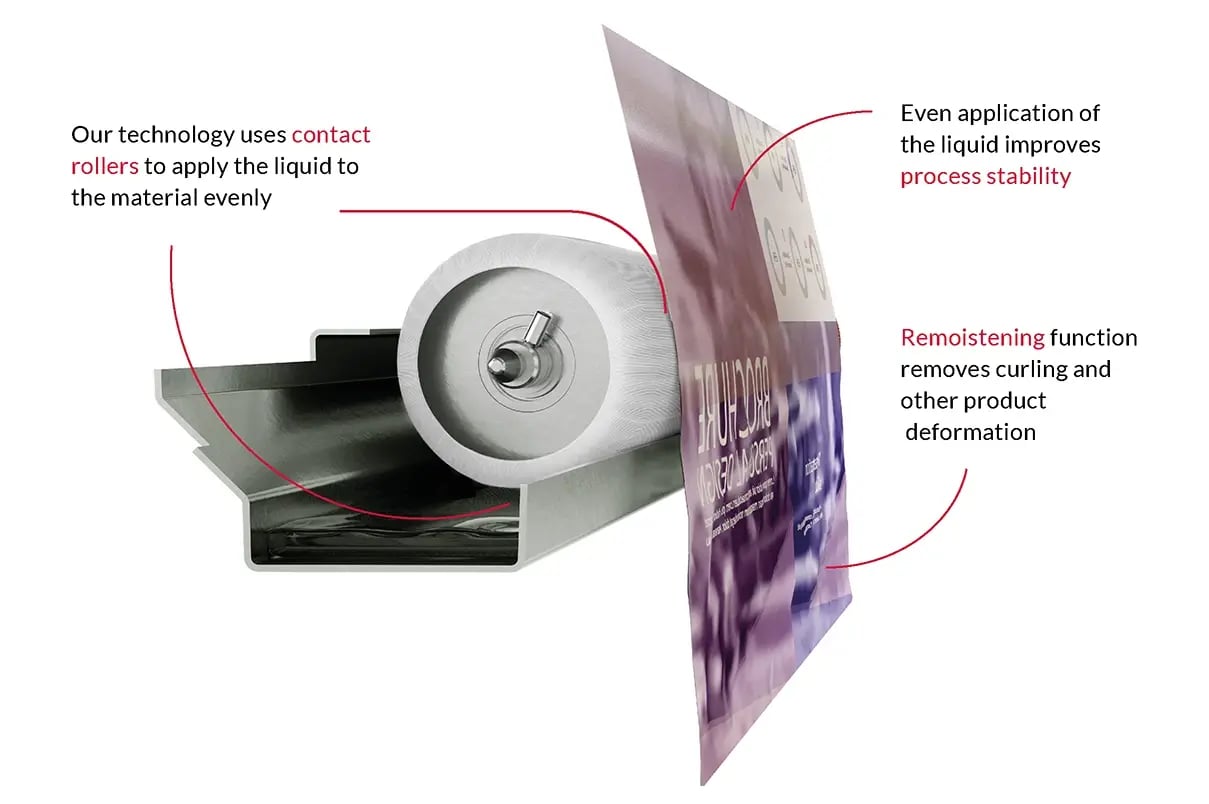
Contact rollers ensure that the applied fluid is transferred in direct contact with the entire web width. This creates a consistent interaction between fluid and substrate, independent of web structure, porosity or local material variations.

Unlike non-contact methods, contact-based transfer:

  • distributes the fluid evenly across the full width of the web

  • avoids local concentration differences or untreated zones

  • is insensitive to airflow, misting or overspray effects

  • ensures predictable results across different production speeds

By mechanically defining the interaction between fluid and substrate, contact rollers create a stable foundation for consistent material behaviour throughout the process.


Precision metering 

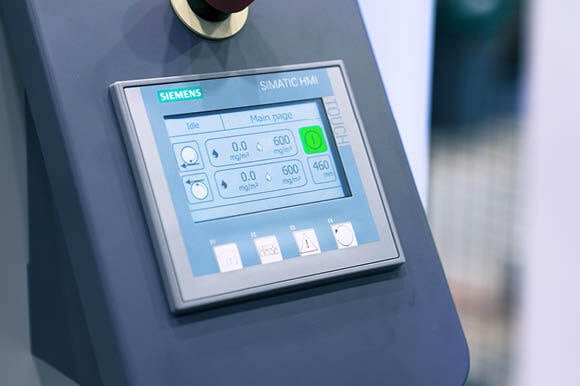
Equally critical is the ability to accurately define and maintain the applied fluid quantity. Contiweb’s metering technology allows the amount of fluid to be set and maintained within tight tolerances, independent of speed or production duration.

Precision metering enables:

  • exact dosing of fluids per unit area

  • consistent application over time and between production runs

  • reproducible process settings across shifts and operators

  • controlled adjustment to match substrate or process changes

This level of control transforms Fluid Application from a corrective action into a controlled process parameter.


From fluid application to process control

By combining contact rollers with precision metering, Fluid Application becomes an integrated and controllable part of the production process. Instead of reacting to material behaviour downstream, manufacturers gain the ability to actively manage moisture, surface properties and electrostatic effects upstream.

This approach reduces variability, improves process stability and supports predictable downstream performance across applications, substrates and industries.

BNiD-C-technologiepagina-TextMedia-580x386-4-1

Request a substrate test

If you would like to determine how fluid application affects the behavior of your specific substrate, we invite you to have it tested in our demo fluid application line. During these tests, our (application) engineering team analyses moisture absorption, dimensional stability and downstream handling effects under controlled process conditions. The results provide practical guidance for process settings, and the expected improvements and feasibility within your production environment.

To discuss test options or technical requirements, you can contact Irene Eggink (Application Engineer) using the details provided alongside this page.

Would you like to learn more?

Irene Eggink
Application Engineer
Call me | Email me 

Portret-rond-Irene-Eggink