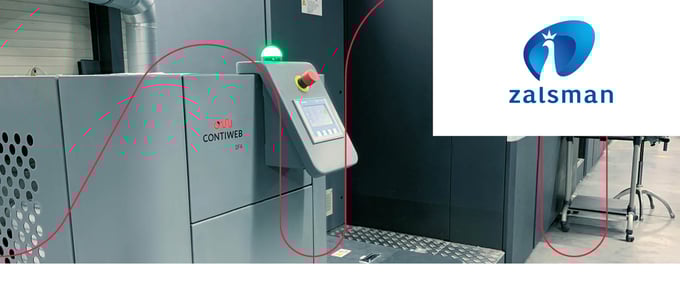

Moderna Printing’s response to shifting market conditions has been to invest in a continuous web-to-sheet production line. You can read the full case study here.
This line, consisting of a Heidelberg Speedmaster XL 106 sheetfed offset press, CutStar reel sheeter and Contiweb CB-N Non-Stop Unwinder, delivers higher productivity, reduced waste and improved efficiency. It also improves operator flexibility and ergonomics.
But how are these gains actually achieved?
In this article, we take a closer look at the factors that drive these productivity gains and cost savings.
Continuous production: increasing output and revenue
In conventional sheetfed setups, feeder reloads introduce planned stops. Each stop interrupts production, reduces effective output and limits the total amount of saleable product that can be produced.
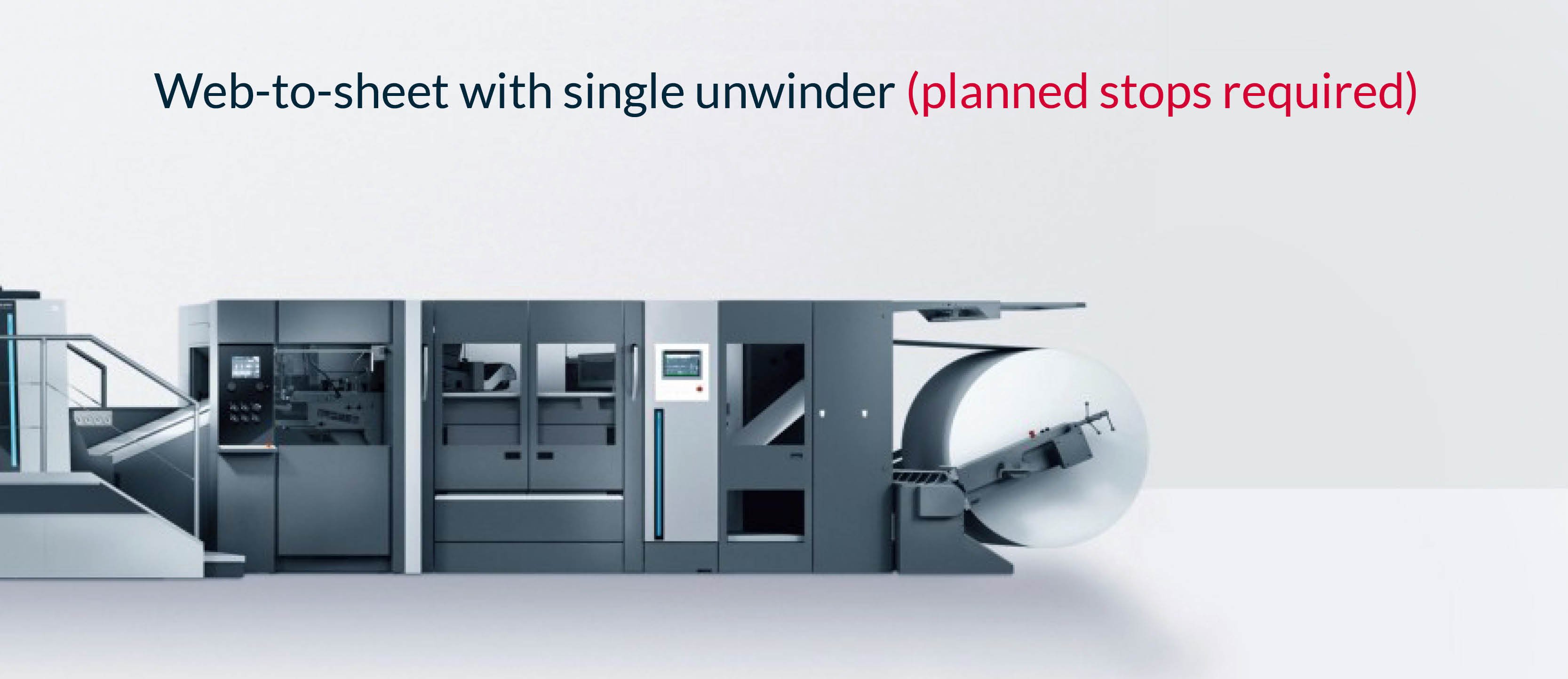
Web-to-sheet with a single unwinder (image above) already reduces the frequency of these stops, as a single reel replaces multiple stacks of cut sheets. However, interruptions still occur.
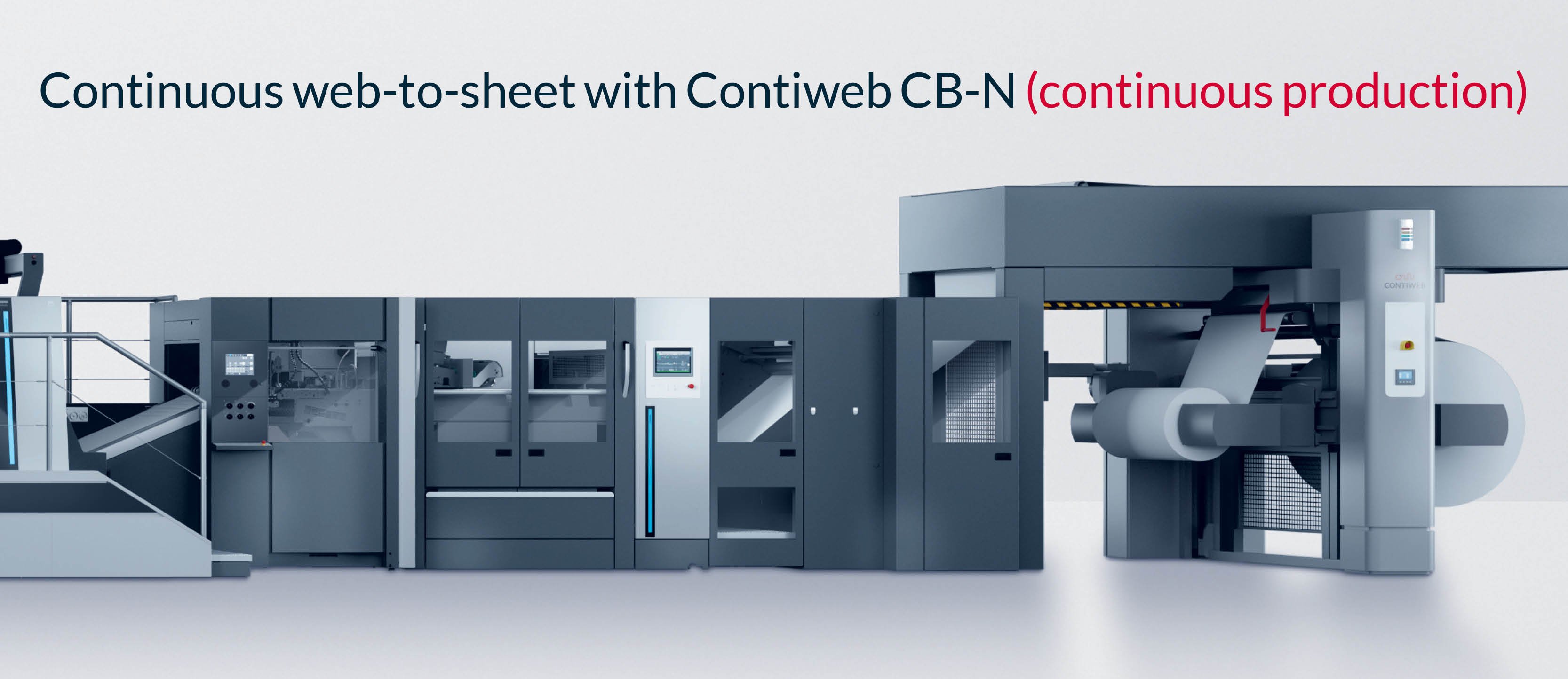
In setups with the Contiweb CB-N Non-Stop Unwinder (image below), these interruptions are eliminated. Reel changes are performed automatically while the press continues running, transforming production from a stop-start process into a continuous flow.
As a result, more production time becomes available, directly increasing output and revenue within the same timeframe.
Higher speeds and more stable production
In sheetfed production, the behaviour of paper during sheet pick-up is often a limiting factor. Variations in feeding can introduce instability, particularly at higher speeds, and lead to feeder-related interruptions such as double sheets or misfeeds.
In a web-to-sheet setup, these constraints are largely removed. Paper is supplied as a continuous web and cut inline, eliminating the need for sheet separation.
Combined with a stable web flow from the Contiweb CB-N Non-Stop Unwinder, this results in a more consistent production process with fewer unplanned interruptions and the ability to run at higher, consistently maintained speeds.
Lower material costs
Paper supplied from reels is typically more cost-efficient than cut sheets. This is due to differences in production, handling and logistics, making reel-based supply structurally more economical.
In a continuous web-to-sheet setup, these cost advantages can be fully utilised, contributing directly to lower overall material costs.
Paper waste reduction
Continuous web-to-sheet printing significantly reduces paper waste compared to both sheetfed production and web-to-sheet setups with a single unwinder.
One of the key drivers is precise inline cutting. The CutStar reel sheeter cuts the paper web to the exact required length, minimising trim waste and improving material utilisation.
Another important factor is how splices are handled. In web-to-sheet setups with a single unwinder, the splice cannot be fed through the press. As a result, the reel sheeter must be emptied and the splice removed before production can continue, generating additional paper waste. The Contiweb CB-N Non-Stop Unwinder allows the splice to pass through the press, reducing waste at every reel change.
Finally, partial reels can be used efficiently without interrupting production. In setups with a single unwinder, these are often left unused because the time required for a reel change outweighs their production value. With the Contiweb CB-N Non-Stop Unwinder, this limitation is removed, reducing both material waste and the need to store, handle and manage leftover stock.
Eliminating non-productive handling time
In web-to-sheet configurations with a single unwinder, a reel change can easily take around 15 minutes of operator time. While necessary, this time does not add value to the final product.
With the Contiweb CB-N Non-Stop Unwinder, splicing is fully automated. The operator only needs to load the next reel and prepare the splice, while the system performs the splice automatically during production.
In practice, this can eliminate dozens of hours of non-productive handling time per week. This reduction can translate into lower labour requirements, fewer shifts or more efficient use of operator capacity.
From reactive to planned operation
In conventional and web-to-sheet setups, stack and reel changes often dictate the operator’s actions. When substrate runs out, operators must react immediately, often under time pressure.
With the Contiweb CB-N Non-Stop Unwinder, this dynamic changes. Reel preparation can be carried out in advance, at a moment that best fits the workflow. This shifts production from reactive to planned operation, creating a more controlled and predictable process with fewer disruptions.
Improved operator ergonomics
Handling reels and managing splice preparation can be physically demanding in traditional setups. For example, operators may need to manually lift a shaft and insert it through the reel, which can be heavy and difficult to handle.
The Contiweb CB-N Non-Stop Unwinder is designed to improve ergonomics by eliminating these manual steps. Using chucks, reels can be lifted directly from the floor and positioned automatically, without the need for manual shaft handling.
In addition, reel handling and splice preparation take place at optimal working heights and positions, supported by mechanical assistance and reel transport systems that allow reels to be moved easily and precisely into position.
This reduces physical strain on operators and contributes to a safer and more sustainable working environment.
From insight to measurable results
Each of the factors described above contributes to improved performance. The real impact, however, comes from how they work together, increasing output, enabling higher speeds, reducing waste and eliminating non-productive handling time.
Every operation is different. The frequency of reel changes or feeder reloads, job mix, production speeds and workflow organisation all influence the potential impact.
That is why we work closely with customers to quantify these effects in practice. Based on your production data, we calculate the expected productivity gains and cost savings for your specific situation.
Let’s quantify what this could mean for your operation. Book a meeting now!