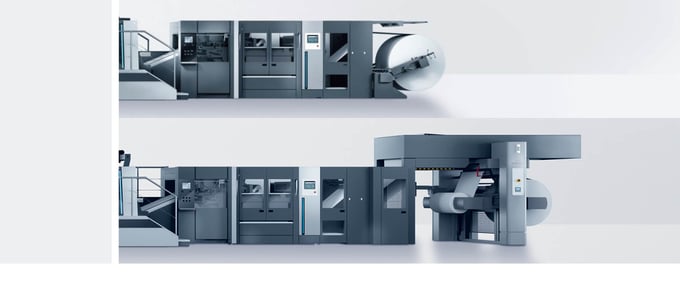

Electrostatic charge is a well-known challenge in high-speed roll-to-roll environments, particularly when processing hygroscopic materials. Web inkjet production is no exception and can also be affected by unpredictable behaviour. At Dutch printing company Zalsman, the effects became apparent in the finishing line: sheets stuck together, paper skewed, and production came to a standstill—at the expense of efficiency.
Zalsman is a modern printing company in the Netherlands with a hybrid production environment in which offset and digital printing complement one another. The company operates as a one-stop print provider, producing runs from a single copy up to 100,000 copies, covering both standard print work and specialised projects.
A pioneer in high-speed inkjet printing
Founded in 1857, Zalsman has experienced every major technological shift in the graphic arts industry. Offset printing long formed the backbone of its production, but the company was an early pioneer of digital printing. In 2015, Zalsman became the first printing company worldwide to install a Ricoh Pro VC60000. “Essentially, we can produce almost any type of print work,” says Peter Hup, Operations Manager at Zalsman. “The real consideration is which technology is the smartest choice for each application.
That vision is clearly reflected in the company’s equipment. In addition to several offset presses, Zalsman currently operates two Ricoh web-fed inkjet press lines: a Pro VC70000 and a Ricoh Pro VC80000, added in 2024. These roll-to-roll inkjet lines enable efficient production of small and medium print runs, variable printing, and rapid transition to finishing. In a market characterised by shrinking run lengths and increasing variation, that flexibility is essential.
Remoistening to resolve waviness and curled edges
When Zalsman invested in the Ricoh Pro VC80000, it was clear to Peter Hup that the line would need to be equipped with a remoistening solution. “When paper is dried at high temperatures, moisture is removed,” he explains. “Because paper is hygroscopic, it later reabsorbs moisture from the environment in an uncontrolled way. That can lead to wavy book blocks and curled paper edges.”
On Ricoh’s recommendation, a Contiweb Digital Fluid Applicator was installed. Once the system had been properly set up, the effect was immediately noticeable. Printed products remained flat and stable, without uncontrolled deformation.
However, another issue emerged—one that did not manifest itself in the press, but further downstream in the process.
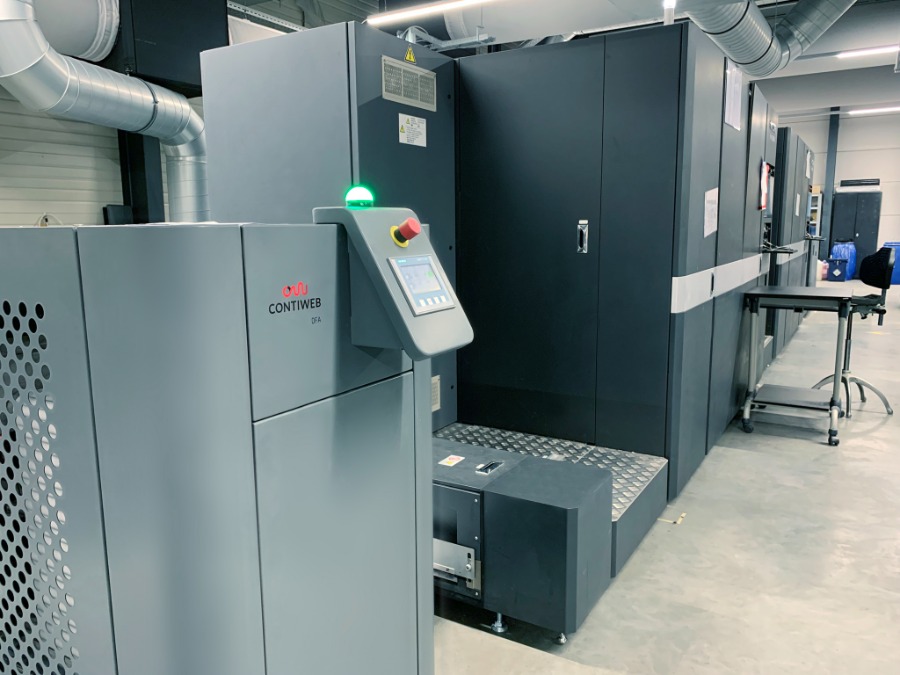
The Contiweb Digital Fluid Applicator (DFA) and the Ricoh Pro VC80000 web-fed inkjet press at Zalsman in Zwolle, the Netherlands.
Static charge as an invisible disruptor
Although moisture balance was well under control, Zalsman began experiencing unpredictable and sometimes extreme electrostatic charge in finishing. “The paper was literally crackling,” recalls Hup. “Sheets stuck together, paper skewed. One day you’d have problems, the next day not. It was impossible to pin down.”
Measurements showed that no static charge was present in the wound roll immediately after web inkjet printing. The electrostatic charge only manifested itself later, when the rolls were unwound again in the finishing lines.
This phenomenon is typical of electrostatic charge in web-based processes. The charge does not originate at a single fixed point but builds up through the interaction of material properties, speed, friction and ambient conditions. In her blog Static Charge: the invisible disruptor in roll-to-roll production, Application Engineer Irene Eggink explains in detail how electrostatic charge develops.
Downtime, waste and frustration on the shop floor
At Zalsman, static charge resulted in waste and unplanned downtime. To limit disruptions, machine speeds were reduced—sometimes with effect, often without. This led to growing frustration among both Peter Hup and his operators.
“The people on the line simply want to produce a good product. When that doesn’t work, the first response is to slow the line down. If that still doesn’t help, frustration builds. If you expect performance from your people, you also need to give them the right tools and ensure that machines do what they are supposed to do.”
Together with Contiweb, the issue was reassessed. While remoistening using water alone often helps to reduce electrostatic problems, in this case the issue proved more persistent.
Controlled application of antistatic fluid
Zalsman was already using the Contiweb DFA for controlled moisture application. The system stands out for its ability to dose fluids with a high degree of consistency and precision. These fluids are not limited to water alone, but can also include functional liquids such as silicone oil, anti-curling agents or antistatic additives.
To assess whether antistatic dosing would be effective in this application, a targeted trial was conducted. Initially, a small amount of antistatic fluid was manually added to the water applied via the DFA. The result was immediately visible.
“As soon as the antistatic fluid was added, the disruptions disappeared. When the antistatic component was temporarily removed later on, the problems returned straight away.”
This provided clear confirmation of the effectiveness of the solution.
Process control through a Contiweb DFA upgrade
Based on these findings, Zalsman opted to upgrade the Contiweb DFA. The required hardware and software were integrated into the existing DFA configuration, allowing operators to easily adjust dosing levels via the HMI. Following the upgrade, the DFA is now able to apply a highly precise amount of antistatic fluid to the paper web in addition to water.
Peter Hup and Contiweb jointly determined the optimal setting. A dosage of three percent proved to be the right setting for virtually all jobs. The impact for Zalsman is significant, while the addition of the fluid remains completely invisible to the customer. “Since then, finishing has remained stable. Paper behaviour is predictable, and operators can once again rely on the line. The biggest gain is not just reduced waste, but above all the fact that frustration has disappeared. People can enjoy their work again.”
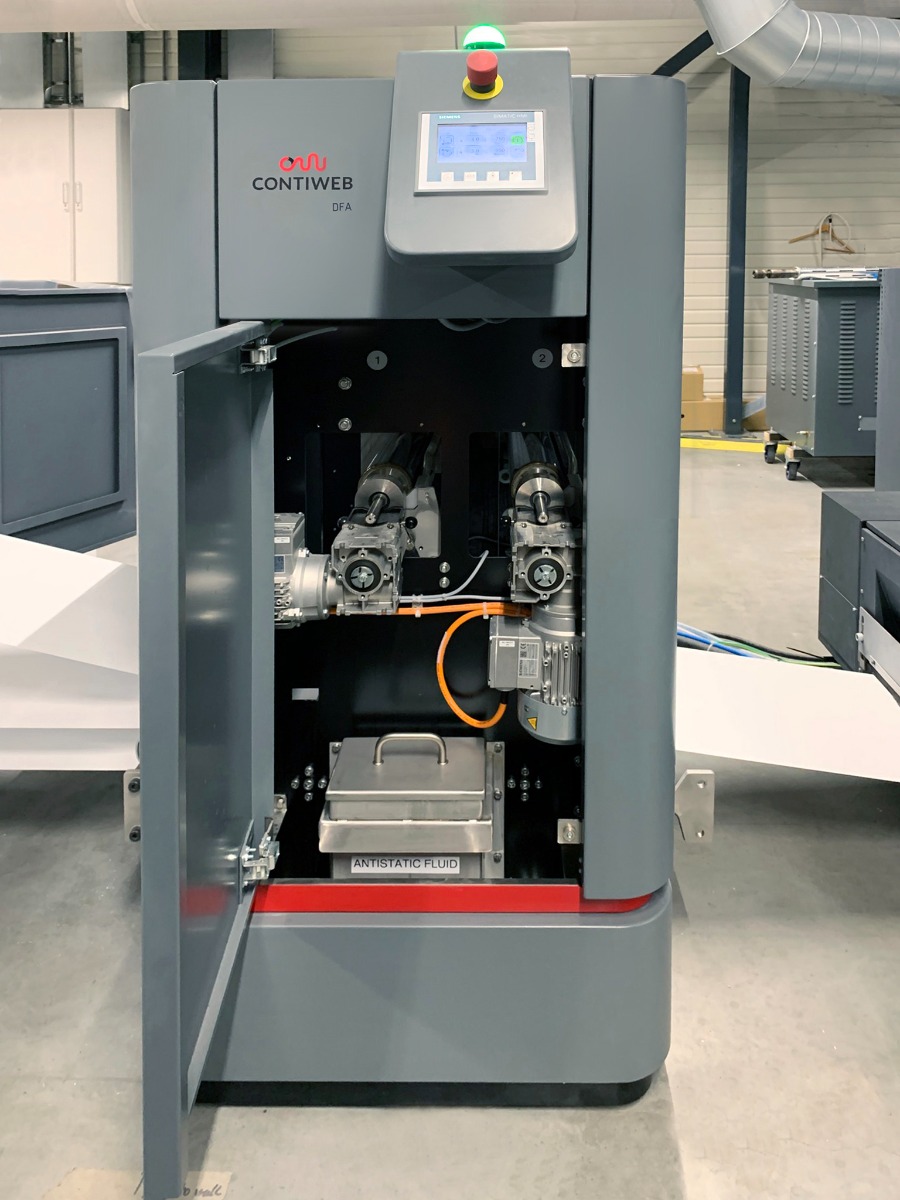
In addition to water, the Contiweb DFA can apply a highly precise amount of antistatic fluid to the paper web.