
Key insights in this article:
- Static electricity is a major but often overlooked cause of jams, sticking or unexplained stops in R2R production.
- Charge builds up when dry materials contact rollers, especially at high speed.
- Low moisture reduces conductivity, causing charge to accumulate and leading to unstable web behavior, dust attraction, or even safety risks (sparking).
- Restoring moisture is the most effective solution: remoistening improves conductivity and dissipates charge.
- Applying an antistatic fluid additive enhances and prolongs surface conductivity.
- Contiweb provides demo-line testing to evaluate how fluid applications improve specific substrates in real production conditions
When machines stop but nothing seems wrong
In high-speed Roll-to-Roll (R2R) production environments, small, invisible forces can have surprisingly large effects. Materials that should glide smoothly through the line start to misbehave, sheets begin to cling, webs suddenly curl, or finished products show unpredictable handling issues. These symptoms often appear random, and they tend to return spontaneously (even after temporary fixes), making troubleshooting difficult. Yet in many cases, the cause is not mechanical, nor related to material quality or operator settings. It’s something less visible, but equally powerful.
Few production challenges are as frustrating as sudden, unexplained stops in the production line. Sheets or webs that stick together, curl, or fail to separate properly can slow down even the most automated systems. In processes such as converting, embossing, coating, or laminating, this often leads to material jams, feeding errors, misalignment, or even damage to sensitive equipment. Operators may try cleaning rollers, adjusting tension, or changing substrate batches. However, the real cause frequently goes unnoticed: electrostatic charge.
Understanding static charge
While most production teams recognise the importance of remoistening (as discussed in our previous blog), the mechanisms that lead to static charge build-up are not always fully understood. Yet static charge quietly affects nearly every dry material handling process and therefore represents a costly problem across many areas of manufacturing.
Static charge means an imbalance of electric charges on the surface of a material or object. It arises whenever two (poorly conductive) surfaces come into contact and then separate: electrons are transferred, leaving one surface positively charged and the other negatively charged. In hygroscopic materials such as paper, carton, nonwovens, cotton textiles, or foil films, this charge imbalance accumulates on the surface. As a result, both surfaces become electrically charged, leading to a static buildup on each material. The drier the material, the worse it gets. The term ‘static’ (non-moving) in static charge is called this way because the charge is stuck and remains on the surface until it can be conducted away. This process is dependent on the surface area and environmental conditions, but also on material properties, see Figure 1 below. The materials, more towards the left, tend to give up electrons and will gain a positive static build-up. The materials on the right will likely attract the electrons, so they will become negatively charged.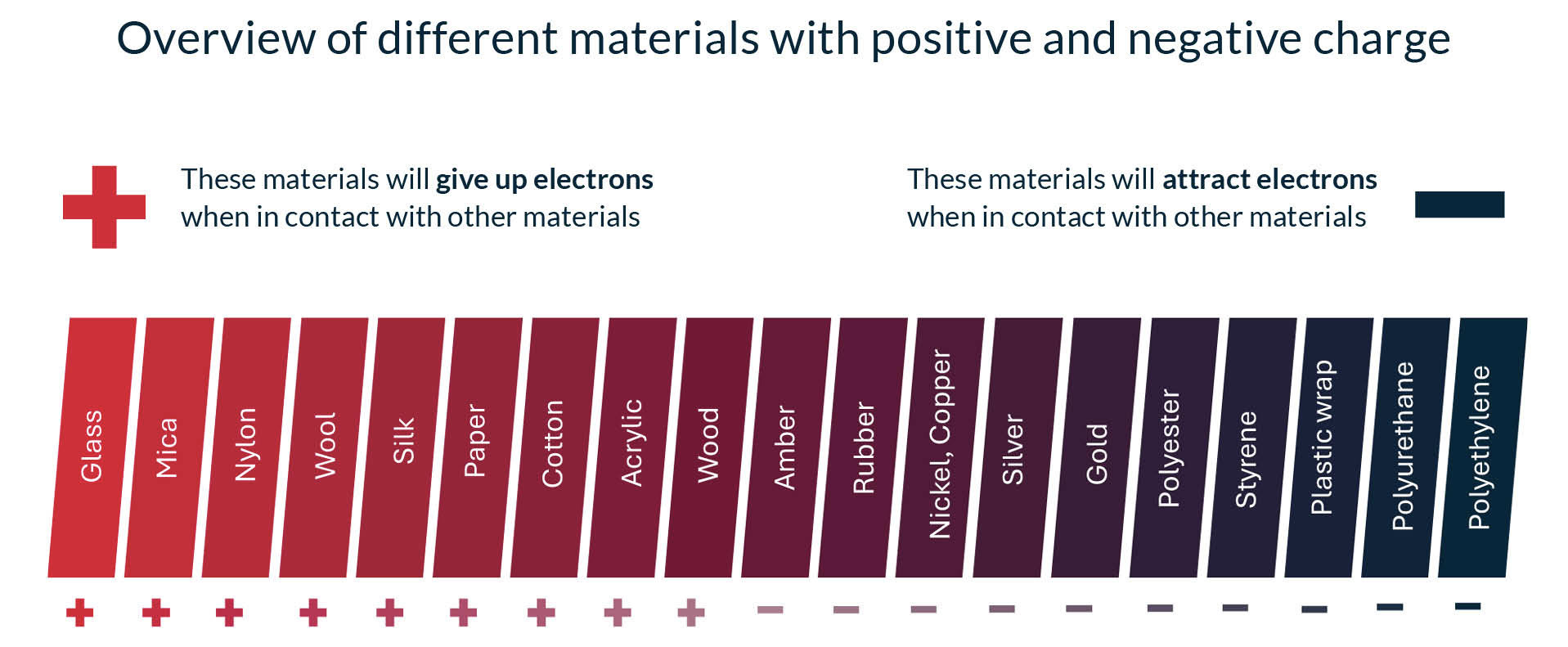
Figure 1: Overview of different materials. Materials on the left tend to be more and easily positively charged when in contact with another material. Going toward the right, materials get more neutral and even more to the right, the materials tend to be easily negatively charged.
Repeated mechanical interactions act as a driving force behind this invisible effect. Every roller, cutting or (un)winding process becomes a charge generator in a high-speed production environment, increasing the electrical potential with each rotation or contact point. The faster the process, the faster the charge accumulates on the product. Figure 2 below shows a web material entering via the left side and contacting the first roller. The contact moment between web and roller causes electrons to transfer between the surfaces. Depending on the material’s conductivity, surface energy and moisture content, the web will donate electrons to the roller. This imbalance creates a surface charge: static electricity. As the web continues over successive rollers, the charge continues to build up, increasing both process instability and the risk of discharge.
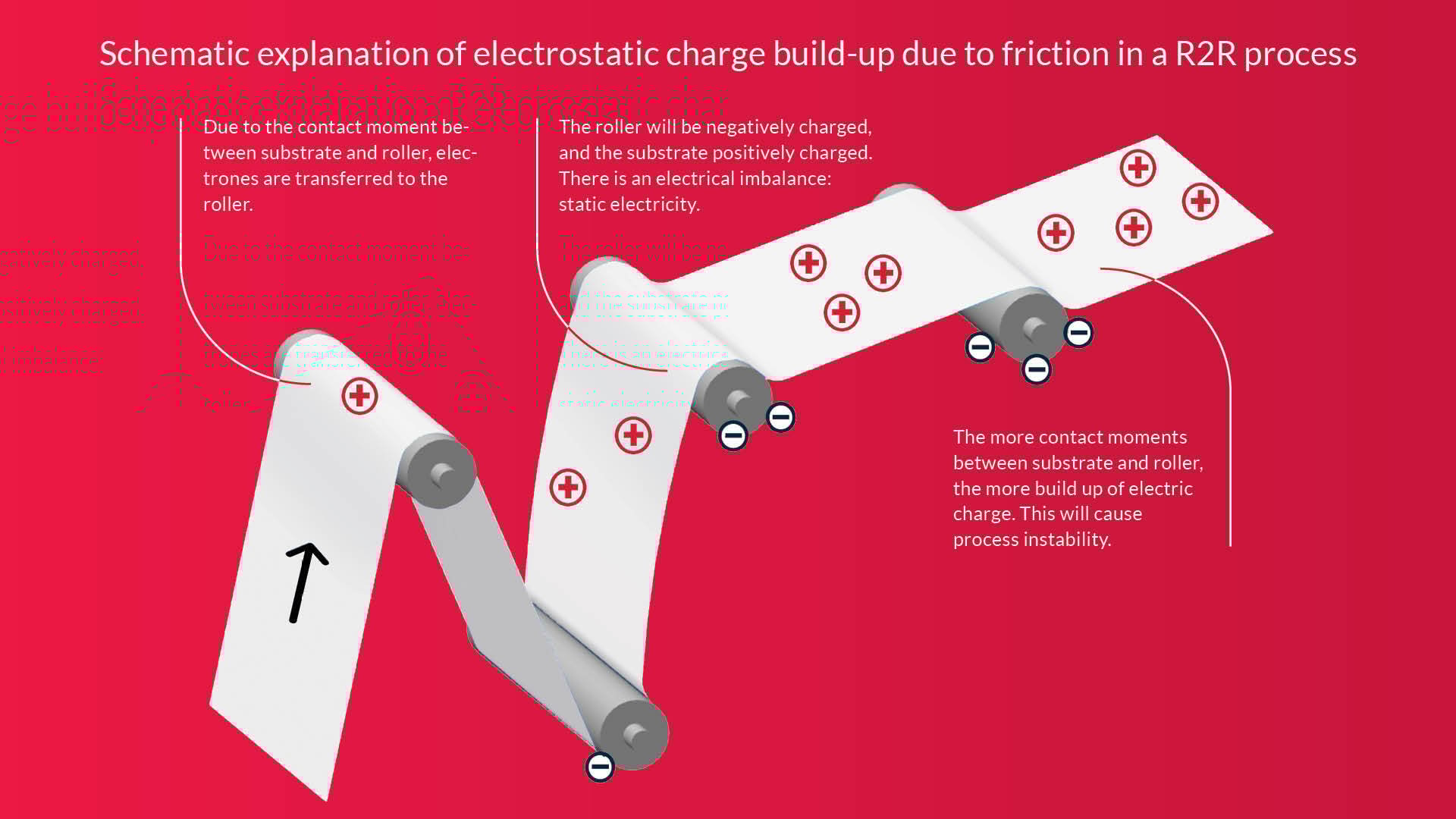
Figure 2: Schematic explanation of electrostatic charge build-up due to friction in a R2R process.
Under normal conditions, water molecules in the substrate act as tiny conductors, allowing ions to move and neutralize charge differences. When moisture content drops, and/or mechanical forces increase, surface conductivity decreases dramatically, and the charge has nowhere to go. This results in sticking, jamming, dust attraction and other ‘mysterious’ process interruptions every operator, engineer or production lead is familiar with.
From a materials science perspective, this phenomenon links directly to surface energy. A dry surface has a higher electrical potential, meaning it attracts opposite charges or polar materials more easily. This is why dry paper tends to cling to rollers, why nonwoven webs can suddenly stick together or why a film web can literally lift off a guide roller and wrap itself around static sources. In extreme cases, static charge can exceed tens of kilovolts, creating not only process instability but also safety risks. The spark generated by static charge can even trigger explosions, which is a common concern in processes such as flexographic printing or coating operations.
Be in charge and take process control
The obvious question is: how can you prevent it? The most effective countermeasure is simple in principle: restore surface conductivity by increasing the material’s moisture content. To be short and clear: add water. Controlled remoistening allows ions to move freely again, enabling charge dissipation across the surface. Once moisture is reintroduced evenly, the electrical potential equalizes naturally, and the static charge disappears. However, for materials that are especially non-conductive or fast drying, such as synthetic nonwovens, coated papers, films, or multilayer laminates, water alone may not be enough. In those cases, Contiweb offers a Fluid Applicator for applying an antistatic fluid additive, enhancing and prolonging surface conductivity. Applied, with or without the remoistening water film, this additive creates a temporary but stable conductive layer, preventing static build-up even under high-speed conditions or low ambient humidity.
Once static charge is neutralized, the entire production flow stabilizes. Sheets separate cleanly, webs track smoothly, and finishing equipment such as folders, coaters, or laminators can run continuously without unplanned stops. In inline printing and finishing, improved static control ensures that sheets or webs don’t stick or repel each other, which leads to more consistent stacking and cutting. In offline processes, the benefits are equally clear: less downtime, higher throughput, and reduced wear on sensitive components like sensors or electrostatic-sensitive drives. In non-print applications such as nonwoven processing, textile finishing, or flexible packaging, static charge can distort lightweight webs or attract airborne dust particles. Moisture management and static control thus go hand in hand, ensuring both dimensional product stability and process reliability, in all types of production steps from unwinding to winding.
At Contiweb, we handle static charge not as an unavoidable inconvenience, but as a controllable process parameter. Our fluid application systems provide precise remoistening, with optional antistatic enhancement, designed to restore conductivity exactly where it matters most.
Request a substrate test in our demo Fluid Application Line
If you would like to determine how fluid application affects the behavior of your specific substrate, we invite you to have it tested in our demo fluid application line. During these tests, our (application) engineering team analyses moisture absorption, dimensional stability and downstream handling effects under controlled process conditions. The results provide practical guidance for process settings, and the expected improvements and feasibility within your production environment.
To discuss test options or technical requirements, you can contact Irene Eggink (Application Engineer) using the details provided alongside this article.