
In short:
- Many recurring quality issues in web-based production like curl, waviness, or stiffness, originate from moisture imbalance in hygroscopic substrates.
- Controlled remoistening restores dimensional stability, flexibility, and process reliability.
- Contiweb’s Fluid Application technology ensures precise, even application of a water-surfactant mixture on one or both sides of the web.
- This technology supports consistent quality, reduced waste, and higher operational control across different materials such as nonwovens, paper, textiles, and wood.
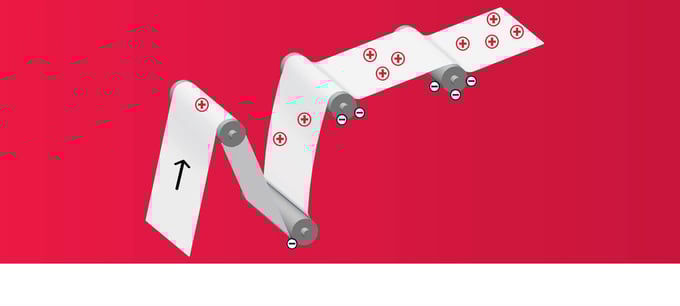
- Maintaining the right moisture level also helps to eliminate static build-up, which will be the focus of our next article on static charge.
Understanding moisture imbalance in hygroscopic materials
Following our previous blog on the introduction of fluid application, this blog takes a deeper look at the moisture imbalance. In many reel-2-reel (R2R) production environments, recurring quality issues such as curled edges, waviness, or surface deformation trace back to a single underlying factor: uneven moisture distribution. Even when substrates are sourced from the same supplier, stored under controlled conditions and processed with identical settings, differences in moisture content can lead to significant variations in mechanical properties, performance and appearance. For most hygroscopic materials such as nonwovens, foils, paper, carton, cotton, wool, wood, and leather, moisture is not just a background condition: it is an active part of the material’s structure.
This blog will dive into the understanding of remoistening and why it’s important to do this in a very controlled way.
Causes and effects of moisture imbalance
During continuous high-speed industrial processes such as coating, embossing, laminating or drying, the materials are exposed to elevated temperatures, mechanical forces and airflow. This combination drives moisture out of the fibers, leaving them depleted and under internal tension. When cellulose or natural fibers lose water (they dry out), the inner structure contracts and the tiny fibers will shrink (Figure 1A). This contraction occurs most intensely on the side exposed to the greatest moisture difference, creating a stress gradient across the material’s thickness. Once the web or sheet cools, this imbalance manifests as curling, waviness or stiffness, resulting in modified mechanical properties. The material might look fine immediately after production, but as it slowly reabsorbs moisture from the surrounding air over time, dimensional changes appear, often affecting further processing steps such as cutting and finishing, but also just rewinding.
Actively adding moisture to the substrate helps to restore this imbalance. However, applying too much on one or both sides can easily create new issues. Introducing uncontrolled humidity or applying too much water can cause fibers to swell unevenly, resulting in cockling, blocked stacks, folding issues, adhesion problems in coating or machine stops due to waviness or other related deformations (Figure 1B). The challenge is therefore not simply to “add moisture,” but to reintroduce exactly the right amount in a uniform and predictable way, and at the correct location in the process.
In short: both extremes, too dry or too wet substrates, compromise production and product quality reliability. The key is to reintroduce precisely the amount of liquid to restore the balance.
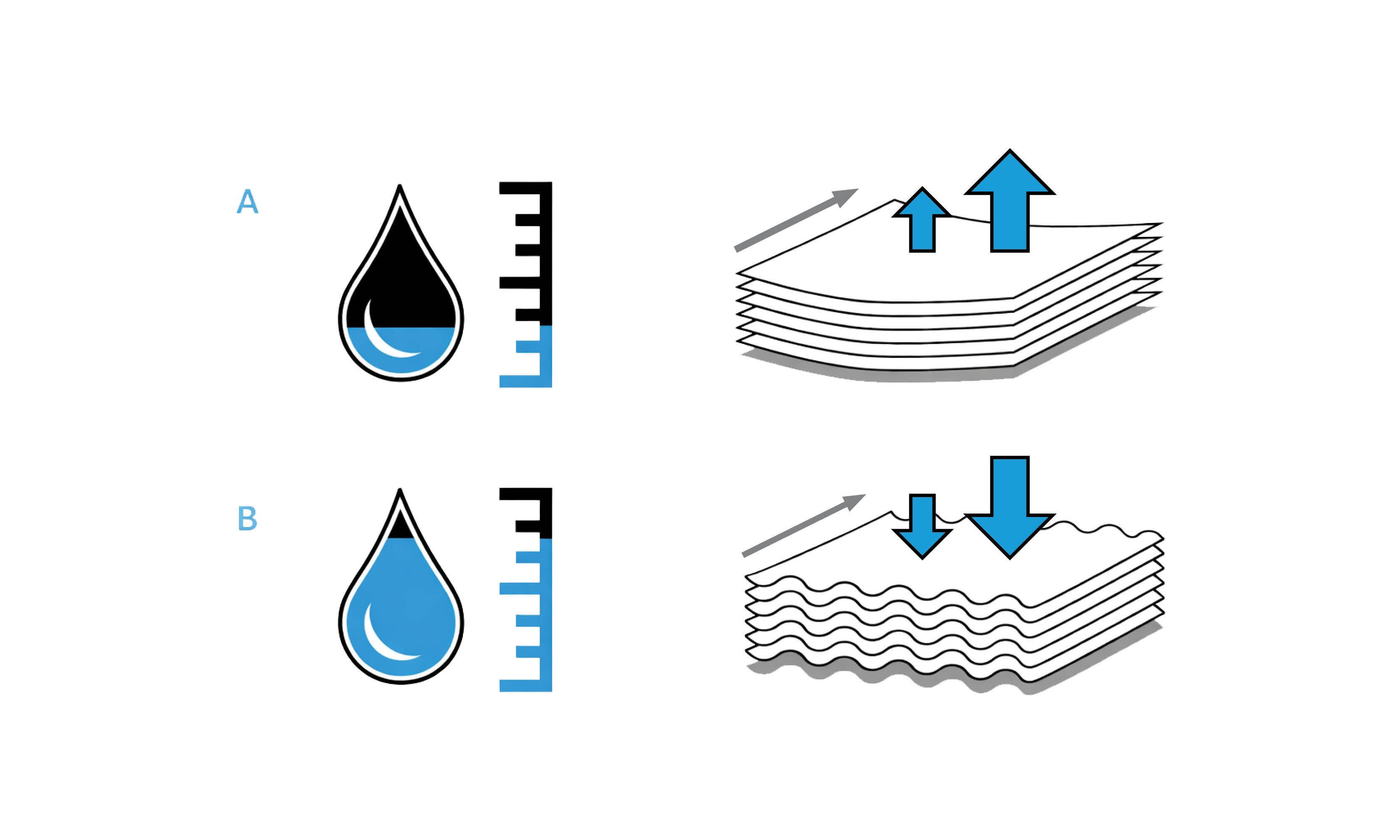
Figure 1 Schematic explanation of the effect of moisture for hygroscopic materials. A) low amount of moisture in environment. The substrate releases moisture and will shrink, resulting in one- or two-sided edge curls. B) high amount of moisture in environment. The substrate absorbs the moisture and will swell unevenly, resulting in waviness.
Controlled remoistening to reach a new equilibrium
At Contiweb, we see moisture management as much more than just conditioning. With our deep understanding of hygroscopic behavior and advanced fluid application technology, we help manufacturers regain control over one of the most overlooked, yet decisive, parameters in production: water. To understand why controlled remoistening has such a strong impact on material behavior, it is helpful to look at the fundamental physics behind moisture interaction.
The physics behind this is straightforward but critical and is driven by hydrogen bonds (OH-bonds):
- Hygroscopic materials naturally absorb water from the air.
- Water molecules form hydrogen bonds with the fiber structure, allowing microscopic movement within the substrate. This softens the fibers, increases their flexibility and reduces internal stress.
- When moisture is lost due to overdrying or friction, these hydrogen bonds break down. This causes the fibers become rigid, brittle, and dimensionally unstable. The microscopic movements are blocked and this leads to handling and processing problems.
- Reintroducing moisture restores these hydrogen bonds, and actively allows the fiber network to relax again, restoring flexibility and dimensional stability. It enables the network to return towards (a new) ideal form.
Hydrogen bonds do not always reconnect at the exact same locations within the fiber network, which means the internal structure, and therefore the mechanical properties, can shift if moisture is reintroduced unevenly. The number of active hydrogen bonds also plays a decisive role in how the material behaves: too few bonds make the substrate brittle and unstable, while too many can cause swelling, waviness, or deformation.
This is why it is essential to add exactly the right amount of moisture to reach equilibrium in a highly controlled and uniform way. The goal is to restore the optimal balance without introducing new mechanical issues.
Applications and benefits of Fluid Application
The benefits of remoistening extend far beyond flattening flexible substrates. In nonwoven web production, for example, moisture affects fiber bonding and web density, especially as manufacturers increasingly use recycled or bio-based fibers with different absorption characteristics. In the wood and panel industry, stable moisture content prevents warping and ensures consistent bonding during lamination. In textile or cotton processing, controlled remoistening maintains fiber elasticity and uniform tension across the web. Across all these applications, the principle remains the same: maintaining equilibrium between the substrate and its environment is essential for consistent quality. Remoistening stabilizes substrate conditions around critical process steps, reducing the need for batch-to-batch adjustments due to predictability and keeping other variable effects consistently under control. Increase quality and save time!
Effective remoistening therefore does more than fix a visible defect: it stabilizes the entire process. A substrate that is balanced in its moisture content remains flat and predictable, even after equilibration. This leads to fewer rejections, less waste, and a more reliable downstream performance. Perhaps most importantly, it gives manufacturers control: the ability to adapt conditions to different materials, widths, or line speeds, ensuring the same level of quality from start to finish.
Key benefits of moisture balance in hygroscopic materials:
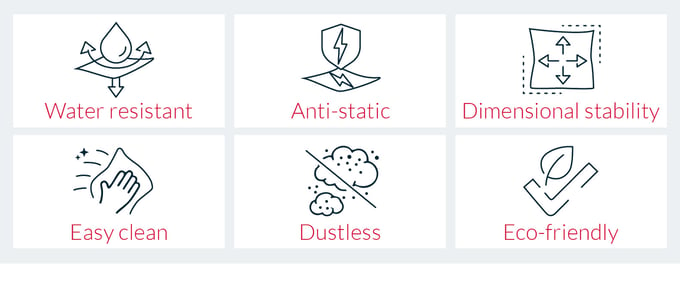
- Dimensional stability
- Mechanical performance
- Process reliability
- Quality consistency
- Waste reduction
- Easier operational control due to predictability
- Reduces static build-up
Our remoistening technology, Fluid Application, provides that control to add the exact required amount for your substrate. By applying a precisely metered and evenly distributed film of water to the substrate, the fibers gradually rehydrate, and internal stress is released. The material regains its natural flexibility and dimensional stability. In our advanced systems, the amount of moisture can be set per side, compensating for i.e. drying asymmetry or coating-induced stress.
Request a substrate test in our demo Fluid Application Line
If you would like to determine how fluid application affects the behavior of your specific substrate, we invite you to have it tested in our demo fluid application line. During these tests, our (application) engineering team analyses moisture absorption, dimensional stability and downstream handling effects under controlled process conditions. The results provide practical guidance for process settings, and the expected improvements and feasibility within your production environment.
To discuss test options or technical requirements, you can contact Irene Eggink (Application Engineer) using the details provided alongside this article.