
In our previous article, Yale Goldis, Head of Strategy at HP PageWide Industrial, explained how changing publisher demands are reshaping industrial book manufacturing. For high-volume monochrome trade books, publishers are reducing first-run quantities and relying on more frequent replenishments. Offset remains the best choice for the longest, most predictable runs, but what happens when a job no longer fits the economics of web offset?
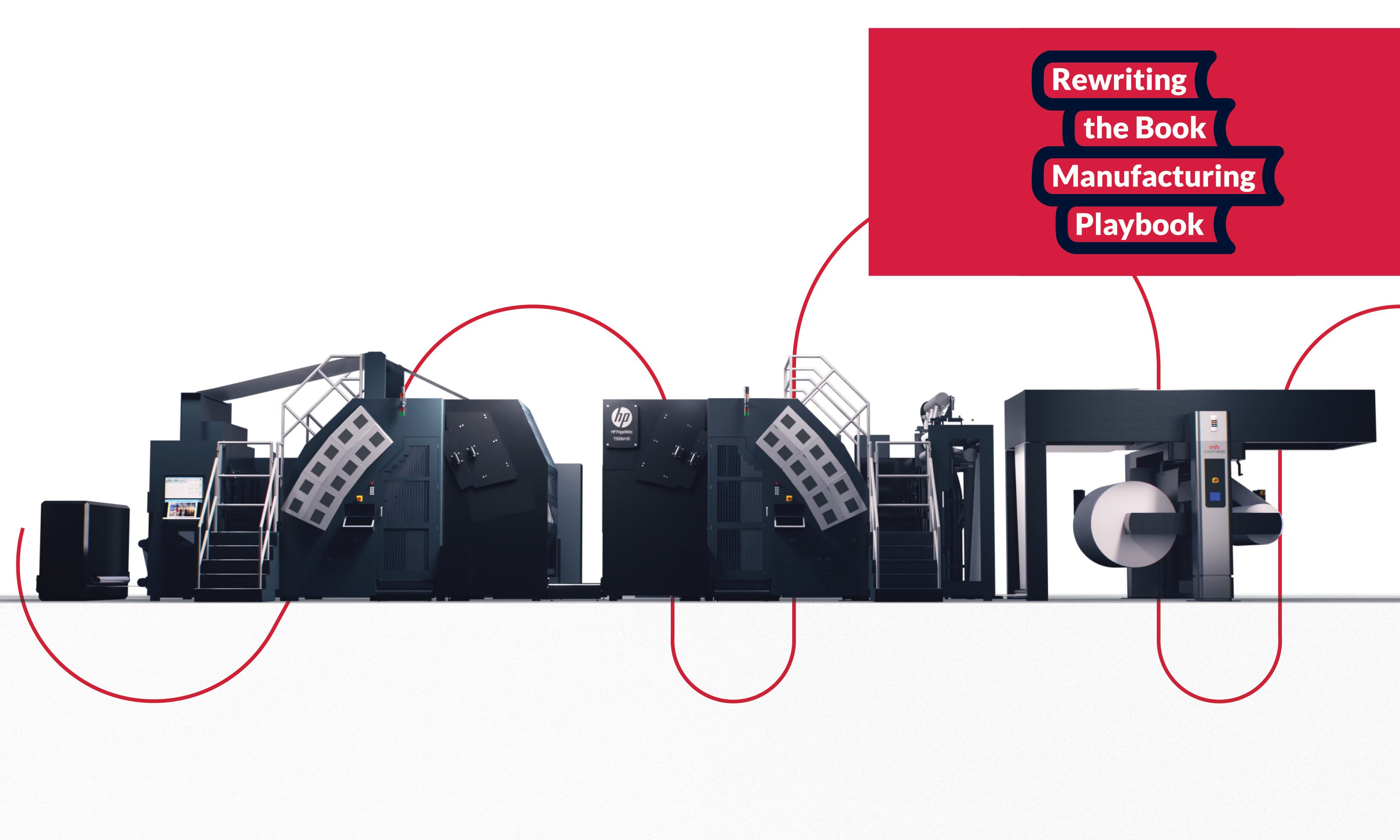
To address the changing requirements of high-volume book manufacturers, HP developed the PageWide T500M HD, introduced at Hunkeler Innovationdays 2025 in Lucerne, Switzerland. We spoke with Jorge Simal, Head of Product, HP PageWide Industrial, and Betsy Huntingdon, Product Marketing Manager, HP PageWide Industrial, about the thinking behind this new production platform.
Designed for a changing trade book market
The HP PageWide T500M HD is a 54-inch (1.4 m) monochrome digital press designed for high-volume book production, particularly trade books in the common 5.5- to 6.5-inch (14–16.6 cm) trim widths. Its 54-inch web width, 1,000 fpm (305 mpm) print speed and compatibility with standard offset media enable manufacturers to produce common trade formats efficiently, including 8-, 16- and 32-page signatures.
According to HP, the T500M HD gives high-volume book manufacturers greater production flexibility while using the same paper widths and substrates as their existing offset platforms. It enables manufacturers to move work more easily between offset and digital production while improving operational efficiency.
For almost two decades, HP has worked with industrial printing partners to develop solutions for high-volume production environments. Jorge Simal says: “Customers wanted a high-volume digital printing solution that integrates seamlessly into existing manufacturing operations using the same paper width as offset devices. The HP PageWide T500 platform gives manufacturers the flexibility to balance production between digital and offset, streamline operations, and expand the digital-offset crossover."
A defining feature of the platform is its 54-inch web width. Betsy Huntingdon explains why: "The T500M HD’s 54-inch web width was chosen to fit into existing offset book manufacturing environments. It allows manufacturers to use the same paper grades, roll widths and signature formats they already use on offset presses, simplifying paper inventory and making it easier to move jobs between offset and digital. Digital production also adds variable cutoff and flexible print width capabilities, which help manufacturers transfer work from different press formats while reducing paper waste."
Productivity goes beyond the press
While press performance is critical, a highly productive book manufacturing line depends on far more than print speed alone. Workflow, printing, web handling and finishing must operate as one connected production system.
That starts with workflow software capable of receiving orders, validating files, imposing pages, batching compatible jobs, scheduling production and sending accurate job instructions downstream. The objective is to minimise manual touchpoints before a job even reaches the press.
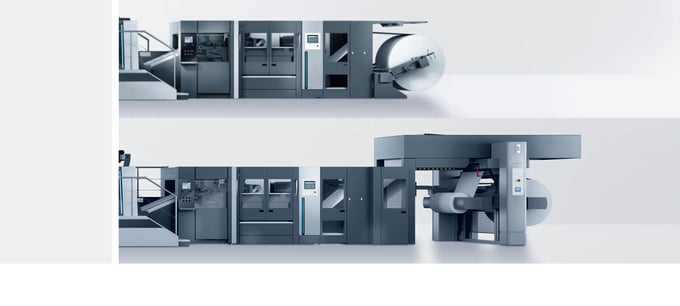
Around the press, continuous production depends on integrated peripheral equipment, including non-stop unwinding and inline book block finishing. The highest-performing production lines connect these systems so roll changes, job transitions and finishing adjustments become managed workflow events rather than manual interruptions.
Continuous production starts with non-stop unwinding
One of the key contributors to continuous production is the Contiweb CD-N Non-Stop Unwinder. By eliminating roll changes as planned production stops, manufacturers can achieve longer uninterrupted production runs, reduce paper waste, minimise operator intervention and improve overall press utilisation.
Achieving that level of integration requires close collaboration between the press manufacturer and suppliers of peripheral equipment. HP and Contiweb have been working together for many years to develop highly integrated production lines for industrial inkjet applications.
According to Jorge Simal, the strength of the partnership lies in the complementary expertise of both companies: "The HP and Contiweb teams share the same practical focus: helping customers run more productive, reliable production lines. Contiweb brings deep expertise in web handling and non-stop unwinding, while HP brings high-volume digital inkjet technology and workflow integration. Together, we help book manufacturers reduce downtime, improve throughput and build more efficient continuous-production environments."
Betsy Huntingdon explains how this integration benefits production: "Productivity gains come from system-level integration, not from adding automation as a standalone device. The non-stop unwinder, press and workflow must communicate and respond as one production line. For example, when the press receives a splice signal, it automatically initiates a sequence to protect the printheads as the splice passes through, while minimising paper waste and preserving uptime. This kind of integration turns roll changes from a production interruption into a managed part of continuous operation."
Early market adoption
Since its introduction at Hunkeler Innovationdays 2025, the HP PageWide T500M HD has already been selected by several high-volume book manufacturers, with multiple presses now installed or in the process of being commissioned. While market adoption is still in its early stages, these early investments indicate that HP has identified a genuine market need for a production platform that bridges the gap between the productivity of web offset and the flexibility of digital printing.
Want to learn more about the role of non-stop unwinding in high-volume book production? Read our article, The case for auto-splicing in modern inkjet book printing.