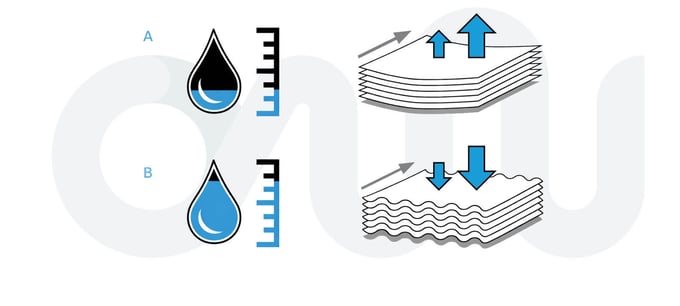

In short:
- Fluid application enables more than a problem-solver for remoistening and static control
- Functional additives can enhance substrate protection, handling, and product quality
- A wide range of fluids can be applied in roll-to-roll processes
- Each application targets a specific process challenge or performance goal
- Discuss your fluid of interest with us or let us test it on your substrate
The wide range of possibilities
In the previous blogs, we explored the fundamentals of remoistening technology, how controlled fluid application can prevent substrate deformation and help eliminate static charge in roll-to-roll (R2R) processes. Now it is time to take a step back and look at the broader picture.
At its core, the fluid application technology is about applying a controlled, uniform liquid layer onto a moving substrate. This seemingly simple principle opens up a wide range of possibilities. Not only in terms of substrate types, but also in the variety of fluids that can be applied. From paper and board to non-woven and specialty materials, and from water-based solutions to functional additives, fluid application can be tailored to specific process challenges and application goals.
In this blog, we walk you through several examples of functional additives and explain how they can be used to improve process stability, substrate behavior, and end-product quality.
Not seeing your fluid of interest listed here? Our technology supports a broad range of liquids. We are happy to discuss your requirements and explore how fluid application can unlock the full potential of your process and product.
Anti-static for reliable web handling
As discussed in our earlier blog on static charge, electrostatic buildup can cause major issues in high-speed R2R processes. This ranges from dust attraction, production stops to unsafe working conditions.
If remoistening is insufficient, anti-static fluids reduce surface resistivity by increasing conductivity at the substrate surface. When applied in a controlled manner, they allow charges to dissipate quickly and predictably. In some cases, standard remoistening already provides sufficient static reduction. However, for demanding applications, such as low-humidity environments, synthetic substrates, or very high web speeds, dedicated anti-static additives may be required to achieve consistent results.
A good example is the customer case with Zalsman, where fluid application with anti-statics significantly improved web stability and downstream handling by actively controlling static behavior.
Silicon oil as substrate protector
Silicon oils are applied in combination with the remoistening application. The function of this oil is to protect the substrate surface during mechanical contact. In manufacturing and converting processes, substrates are exposed to friction from rollers, guides, folders, or finishing equipment. This can lead to marking, smearing or surface damage, especially on sensitive or freshly printed materials.
By applying a thin, uniform silicon oil layer, surface friction is reduced, resulting in:
- No sticking, smearing or other unwanted buildup issues
- Reduced wear
- Eliminates dust attraction
- More stable and consistent operation
- Increased process window such as higher speeds
This approach is commonly used in digital printing and finishing environments, where consistent surface protection helps maintain product quality and reduces unplanned downtime.
Lotion and specialty fluids for the optimal surface performance
Beyond functional protection, fluid application can also be used to optimize material properties. It opens the doors to actively design the characteristics of your product! Examples include lotions and conditioning fluids that improve smoothness, flexibility, absorption capacity or tactile feel of the substrate.
These fluids are typically applied in very low volumes, yet they deliver a noticeable impact such as:
• Improve surface smoothness and other properties according to your wishes
• More predictable downstream converting behavior
• Folding and stacking performance
• End-user perception of quality
Such applications are particularly relevant in packaging, graphic arts, specialty paper and non-woven markets, where both process efficiency and product feel matter. Fluid application enables you to move beyond standard materials and create products with clearly defined application-specific performance characteristics (some examples showed in below picture).
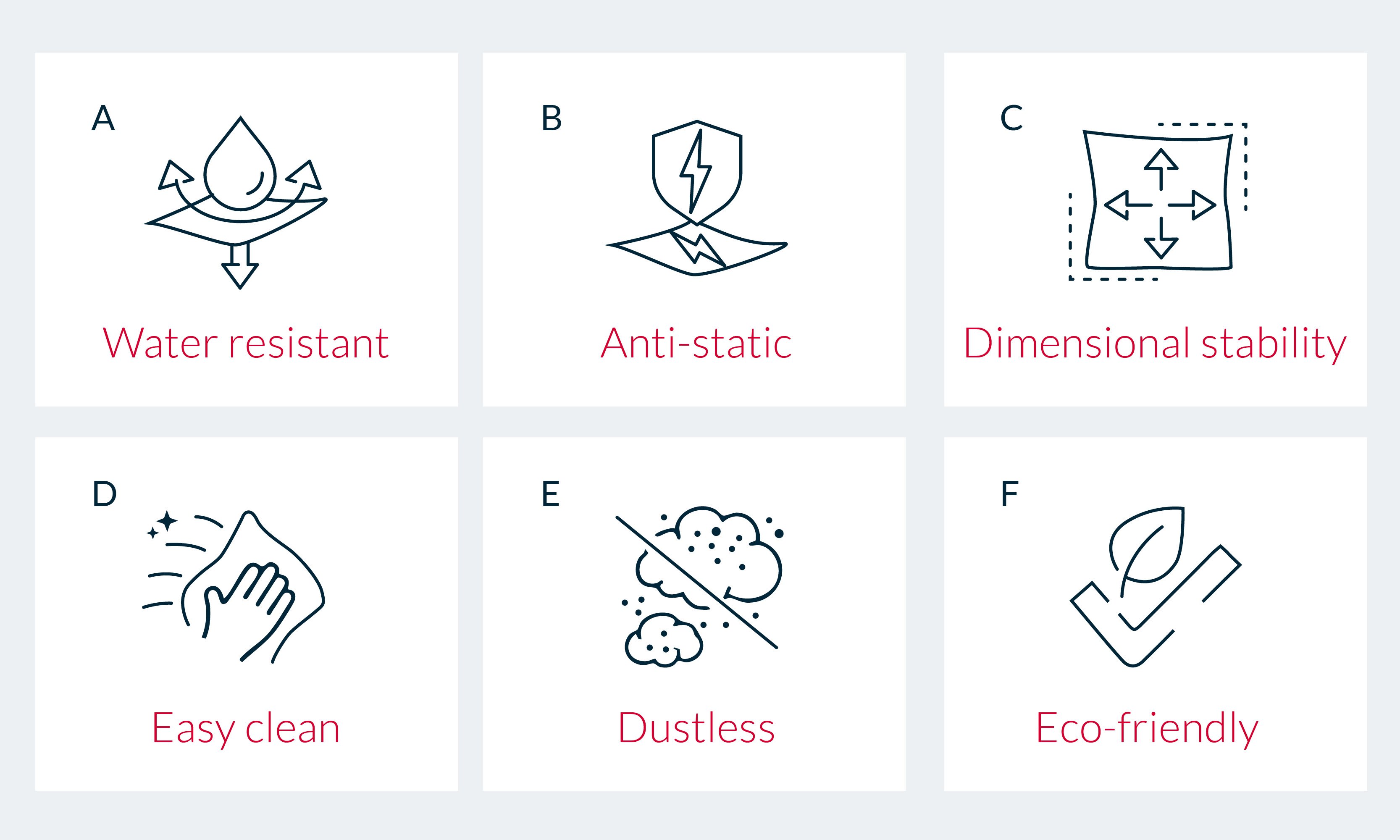
Several examples of functional fluid additives and performance benefits. A: Protects material from water and moisture. B: Conductive layer eliminates static charge. C: Minimizes material expansion, shrinkage and deformation. D: Surface treatment improves cleanability. E: Additives reduce dust formation. F: Very precise metering and more sustainable materials are applicable.
Anti-curl fluids for dimensional stability
Curling and dimensional instability are common challenges in roll-to-roll processes, particularly when substrates are exposed to uneven drying, heating or coating steps. Even small variations in moisture or surface tension can result in curled substrates, unstable web transport or problems in downstream finishing.
Anti-curl fluids are designed to rebalance internal stresses within the substrate by locally adjusting moisture content or surface characteristics. When applied in a controlled and uniform manner, these fluids help the substrate remain flat and dimensionally stable throughout the process.
The practical benefits are clear:
- Improved substrate flatness and stack quality
- Reduced stops, jams and handling issues
- More consistent converting accuracy
- A wider and more stable process window
Because the fluid is applied in-line, anti-curl solutions offer an effective way to improve substrate behavior without adding complex mechanical adjustments or additional process steps. This makes them particularly valuable in high-speed, high-quality printing or converting environments where consistency is critical.
Request a substrate test in our demo Fluid Application Line
If you would like to determine how fluid application affects the behavior of your specific substrate, we invite you to have it tested in our demo fluid application line. During these tests, our (application) engineering team analyses moisture absorption, dimensional stability and downstream handling effects under controlled process conditions. The results provide practical guidance for process settings, and the expected improvements and feasibility within your production environment.
To discuss test options or technical requirements, you can contact Irene Eggink (Application Engineer) using the details provided alongside this article.