
Key insights in this article:
- Water-based technologies are increasingly used to reduce VOC emissions, improve safety and support more recyclable material structures.
- The transition goes beyond replacing solvents, as water-based coatings can also provide alternatives to conventional plastic barrier layers.
- The shift to water-based chemistry is not simply a replacement of one liquid with another, but involves different applications, chemistry and production processes.
- Water-based formulations introduce new drying challenges, with some bio-based formulations being particularly sensitive to how water is removed.
- At industrial scale, water-based applications can require manufacturers to adapt their drying process to handle higher evaporation loads without limiting production speed or product quality.
Environmental demands drive changes in coating chemistry
Across the paper, packaging and converting industries, growing demands for lower emissions, safer production, improved recyclability and reduced use of fossil-based materials are driving changes in the chemistry applied to web-based materials.
Coatings, adhesives and other functional treatments give paper, films and other substrates the properties required for their final application. They can create barriers against water, oil or grease, make a label stick to the surface, improve printability, provide heat-seal properties or add other functionality to the substrate.
Traditionally, many of these functions have relied on solvent-based chemistries, plastic layers or other materials that deliver excellent performance but can present challenges in terms of emissions, safety, recyclability or environmental impact. Today, manufacturers are increasingly exploring water-based alternatives.
From solvent-based to water-based
Solvents, like toluene and MEK have traditionally played an important role in industrial coatings and adhesives. They can enable excellent wetting and controlled application, while their volatility allows for rapid evaporation, and they remain essential for some demanding applications. However, they also come with disadvantages. Many organic solvents are volatile organic compounds (VOCs) and are released into the air during drying. VOC emissions have a negative environmental impact and contribute to air pollution. Their use may therefore require additional measures for ventilation, emission control, fire protection and explosion safety.
Instead of dissolving or carrying the functional material in an organic solvent, water-based formulations use water as the main carrier and contain little to no VOC compounds. Therefore, they reduce the VOC emissions and the use of potentially harmful organic solvents, making them a more environmentally friendly and safer alternative for many applications. Examples include acrylic and polyurethane dispersions, water-based barrier coatings, primers and a wide variety of adhesives. Water-based adhesives are already widely used in applications involving paper, labels, tapes and packaging, while development continues to expand their performance range.
However, for manufacturers and converters, the shift from solvent-based to water-based chemistries can introduce new production challenges. It is not simply a change in chemistry. It can also change the requirements of the production process. Different formulations can require different process conditions and place new demands on production speed, energy use, process stability and existing equipment.
Replacing plastic barriers changes the production process
The shift from solvent-based to water-based chemistry is not the only development increasing the use of water-based technologies. In paper and board, manufacturers are also looking for ways to reduce conventional plastic barrier layers while maintaining the functionality required for the final application.
Food packaging, for example, may need resistance to water, moisture, oxygen, oil and grease. Traditionally, some of these properties have been achieved by adding polyethylene or other plastic barrier layers. As demand grows for recyclable, fiber-based packaging and reduced plastic use, chemical suppliers, paper manufacturers and converters are developing new functional barrier technologies. Water-based dispersion coatings are one of the solutions being introduced to reduce or replace these conventional plastic layers.
These coatings are becoming increasingly sophisticated. New formulations are being developed to combine functions such as moisture, oxygen and grease resistance, and in some cases heat-seal properties, while maintaining the recyclability and performance of the paper-based packaging. The move towards PFAS-free grease resistance is adding another driver for the development of new barrier technologies.
This means that the transition to water-based chemistry does not always involve replacing a solvent-based coating with a water-based alternative. It can also introduce water-based chemistry into a production process that previously worked very differently. A polyethylene barrier applied by extrusion, for example, involves applying a molten polymer and cooling it. When that functionality is replaced by a water-based coating, a liquid is applied instead and the water needs to be evaporated. This introduces an entirely different drying requirement into the production process.
Bio-based is the next dimension
At the same time, manufacturers are looking beyond the carrier liquid itself. Water-based does not automatically mean bio-based. A water-based acrylic dispersion, for example, can still contain polymers derived largely from fossil-based raw materials. However, there is growing interest in replacing at least part of those materials with renewable alternatives. Starch is already well established in paper and adhesive applications. Other developments include cellulose and nanocellulose, natural polymers and other renewable raw materials.
This adds a third development to the transition towards water-based technologies. Alongside the move from solvent-based to water-based coatings and adhesives, and from conventional plastic barriers to water-based barrier coatings, manufacturers are also looking to replace fossil-based functional materials with partially or fully bio-based alternatives. Increasingly, these developments come together in new formulations and applications.
This can introduce additional processing challenges. Some bio-based formulations require relatively high amounts of water, while their final properties can be sensitive to how that water is removed. As a result, the drying process can become even more important when these materials are scaled up to industrial production.
What does this mean for manufacturers and converters?
For companies processing these materials, the challenge is to turn new formulations into reliable industrial production. Contract coaters may need to accommodate new formulations for their customers, specialty paper manufacturers can add new functionality to their products, and tape, label and packaging manufacturers may adopt new adhesive and barrier technologies.
A formulation that performs well in the laboratory still needs to perform consistently on an industrial production line. At higher web speeds and application weights, differences in application method, process conditions and available processing time can affect how the formulation behaves.
Industrial scale-up is therefore not only a technical challenge, but also a commercial necessity. New materials need to be processed reliably and efficiently at production speeds that make them economically viable. The ability to achieve sufficient throughput at a competitive cost can ultimately determine whether a promising new technology moves beyond niche applications and achieves broader market adoption.
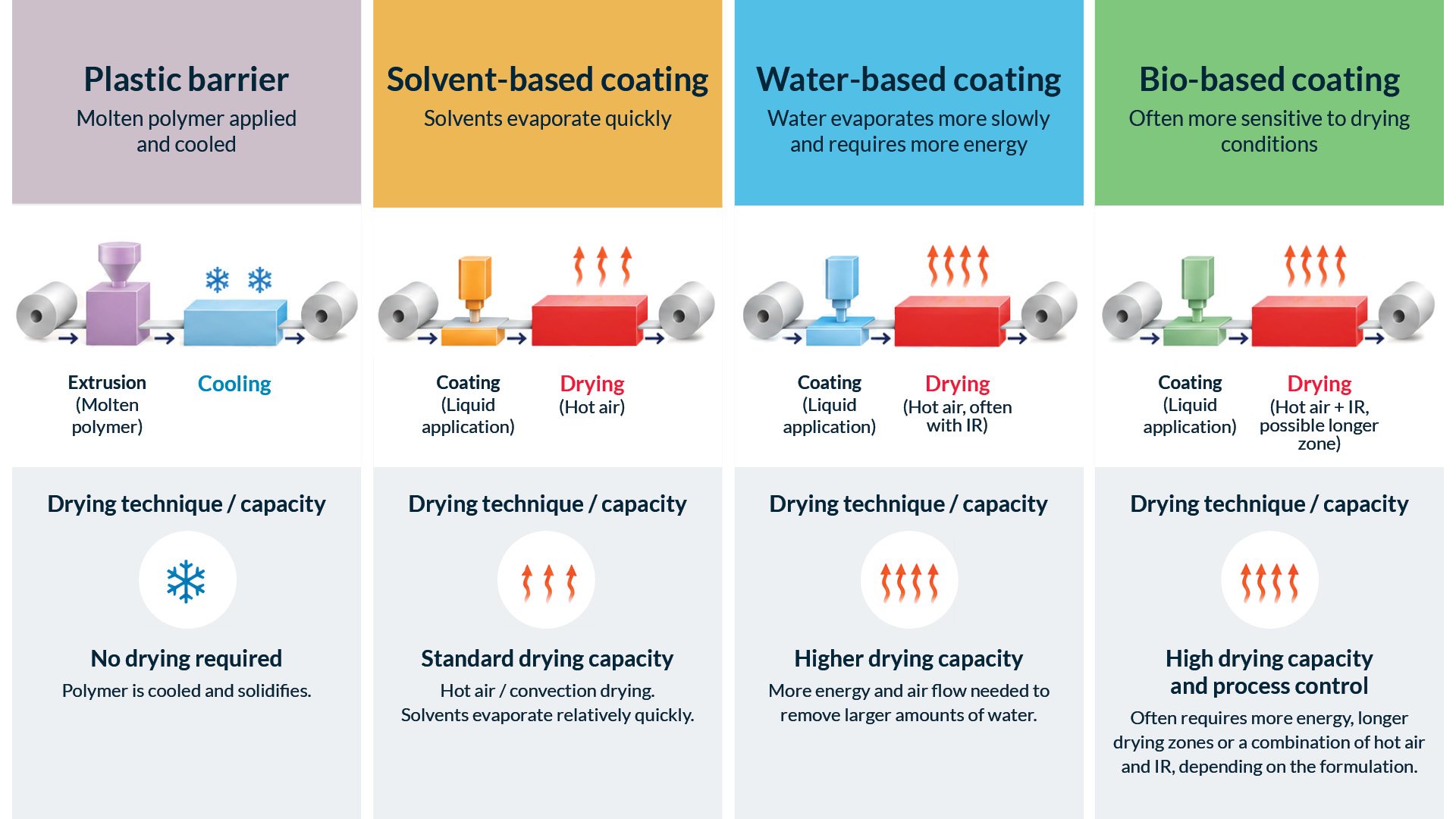
Moving to water-based chemistry is therefore not simply a material substitution. It can also place different demands on the production process and equipment.
New chemistry and production processes lead to new drying requirements
One of the most important process implications is drying. When a water-based liquid is applied to a web, the water subsequently has to be removed. At industrial scale, the quantities involved can be substantial. The evaporation load depends on the combination of many variables like web width, production speed, application weight and solids content. Together, these variables determine how much water needs to be removed within the available drying time.
This raises an important question for companies introducing new water-based applications: can the existing drying process handle the required evaporation load without limiting production speed or product quality?
That is the subject of our next article.