
Key insights in this article:
- Water-based coatings require a different approach to drying than other coatings (film/water-based coatings).
- Drying conditions influence coating formation and the final performance of the coated material.
- Barrier coating helps paper and board resist moisture, grease, oil, and other external influences.
- Understanding the drying process is essential for bringing new coating applications into industrial production.
In our previous blog, we explored how the shift towards water-based barrier coatings is creating new opportunities for packaging manufacturers, while also introducing new challenges in industrial production. But what happens after a coating has been applied to a moving web of paper or board?
The next step is to dry. And while it may sound straightforward, removing the liquid from a coating without compromising its performance requires careful control of the process.
What are barrier coatings, and why are they important?
Barrier coatings are functional layers that give a product a certain mechanical strength, or protect a material against substances such as water, moisture, oil, grease or oxygen. They help give paper and board the properties needed for specific (packaging) applications.
For example, paper packaging for food may need to resist grease, while packaging for dry products may require protection against moisture. Depending on the application, barrier coatings can also contribute to heat-sealability, allowing packaging to be closed without relying on a conventional plastic layer.
Traditionally, some of these functions have been provided by plastic films or laminated structures. As manufacturers look for ways to reduce (single) plastic use and improve the recyclability of fibre-based packaging, water-based barrier coatings are becoming an increasingly relevant alternative.
These coatings are applied as liquids, after which the water must be removed to form the intended functional layer. Their performance depends not only on the coating formulation, but also on how it is applied and dried.
Drying is therefore an important part of the overall process. The objective is not merely to remove water, but to achieve the barrier properties required for the final packaging product.
How does industrial water-based drying work?
When a liquid coating is applied to a moving web, the liquid needs to be removed to leave behind a functional layer. In water-based barrier coatings, this means evaporating the water. At the same time, temperature plays an important role in film formation and, depending on the coating chemistry, curing or crosslinking. The dryer therefore has two key functions: removing the liquid carrier and enabling the coating to develop its intended properties.
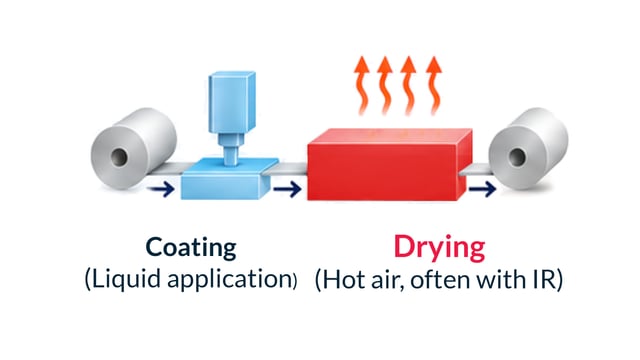
Achieving this requires a balance between sufficient energy for evaporation and the right temperature conditions for film formation and curing. The liquid must be able to move from within the coating to the surface and evaporate. If the surface dries too quickly, deeper layers may retain moisture. Excessive airflow can also disturb the wet coating, while uneven temperatures can lead to an inconsistent coating layer or defect (holes).
Controlling both airflow and temperature is therefore essential. The airflow must be sufficient to remove evaporated moisture without disrupting the coating, while a uniform temperature helps create a consistent, continuous film. This is also why infrared heating is not always the best solution: uneven radiation and local hotspots can make it more difficult to achieve uniform drying and coating quality.
The challenge is to achieve the required level of moisture removal with optimal drying efficiency, while maintaining the coating and substrate within their required temperature limits for proper film.
Too little drying can leave residual moisture, affecting the coating's final properties or the next production step. Too much heat, or drying too aggressively, can damage the substrate or interfere with coating formation. The right balance depends on the formulation, coating weight, substrate properties, and production speed. Effective drying is therefore not simply about applying more heat. It is about delivering the right amount of energy under the right process conditions.
One drying concept, different applications
The drying requirements of a conventional coating, a water-based barrier coating and a new bio-based formulation can differ considerably. Differences in water content, coating weight, substrate and production speed all influence how much energy is needed and how the drying process should be controlled.
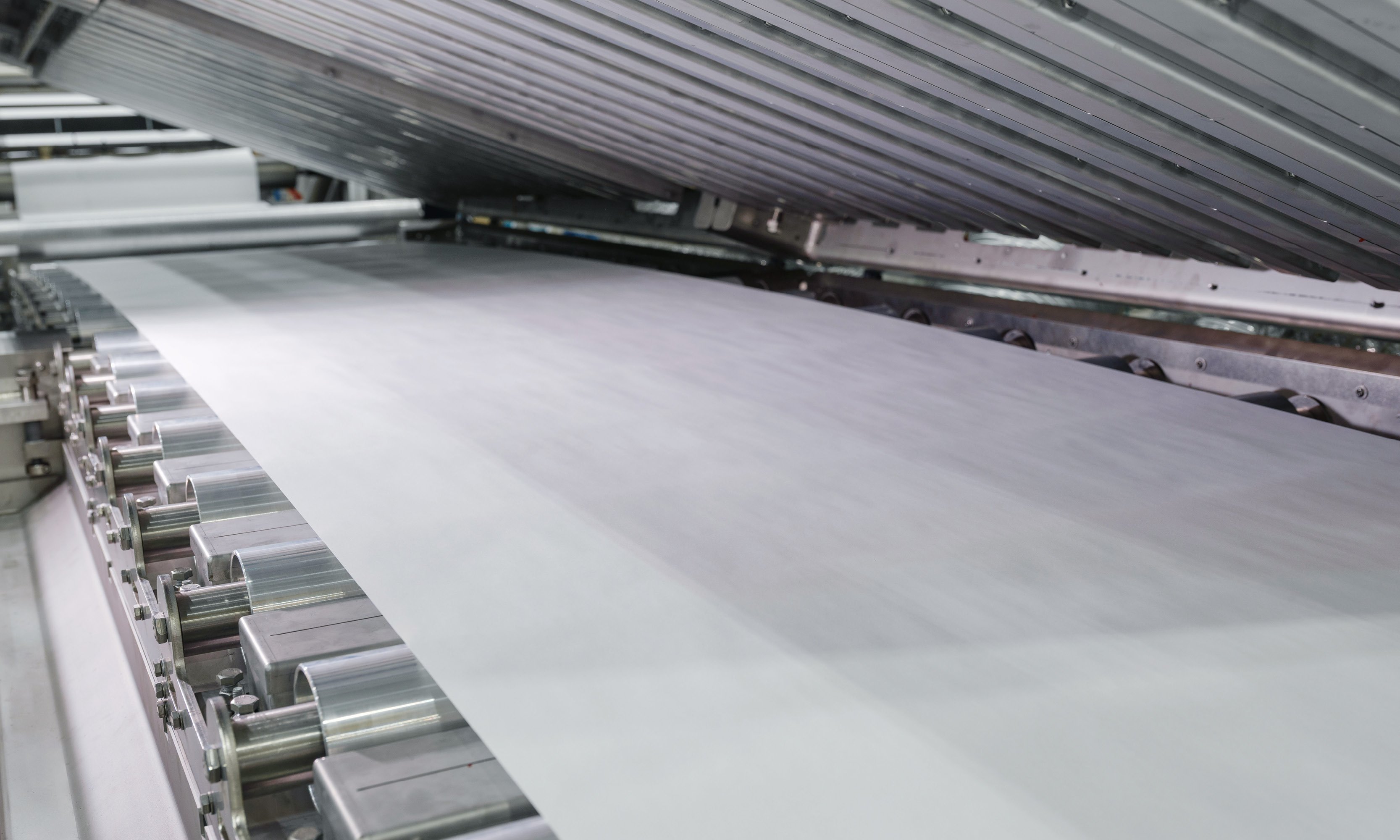
This is where a flexible approach to dryer design becomes valuable. The Contiweb Modular Dryer is designed around the principle that drying requirements depend on the application. Its modular concept allows the drying solution to be tailored to specific process needs, rather than relying on a one-size-fits-all approach.
For manufacturers introducing new coatings or scaling up existing applications, the key question is how to achieve the required product performance without compromising production speed, process stability or energy efficiency.
Understanding the drying requirements is the first step. Applying that knowledge in a real production environment is where the practical value becomes clear.
In our next blog, we speak with a company already using a Contiweb Modular Dryer in production to explore its experience and the role drying plays in its process.